Homeowner Name
Anonymous
About (information sourced from public biographical records)
Epstein Connection?
 DETECTIVE
 RESEARCHER
 EDITOR
Property Details
Wealth Score
—
Wealth Source
—
Professional Category
Business
Fame Score
—
Board Memberships
—
Influence Score
—
Architectural Digest Issue:
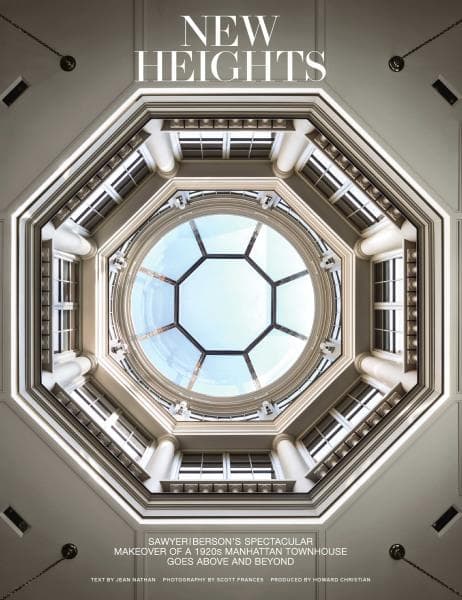
“new heights”
by Jean Nathan
Home Score Summary (Custom Aesthetic Scoring Instrument v2.3)
A Federal-era Manhattan townhouse reimagined as a cultural crossroads where 18th-century European architecture hosts a serious Asian art collection under a soaring octagonal cupola. Sawyer|Berson's renovation is both ambitious and disciplined — the cipollino marble bathroom and four-story atrium are theatrical moments inside an otherwise warm, paneled, rug-rich home designed for a large family that also collects seriously. The result is a grand house that performs its history convincingly while remaining, improbably, a home for five children and their hamsters.
Feature Pages
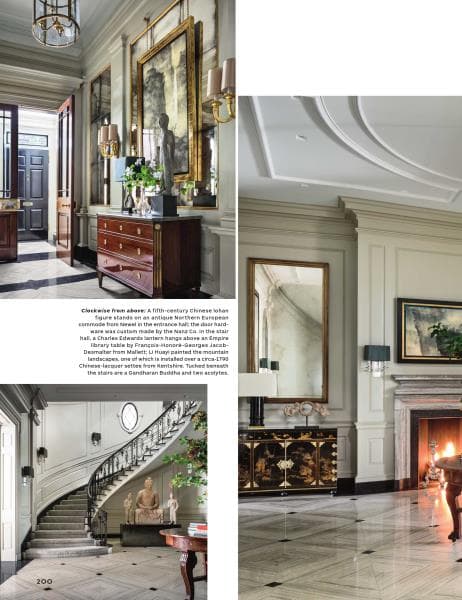
 p.196
p.196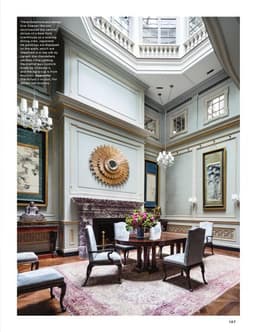 p.197
p.197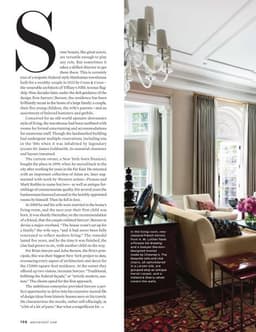 p.198
p.198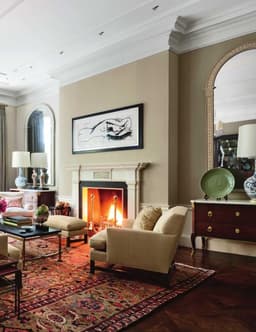 p.199
p.199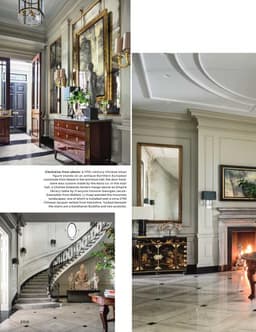 p.200
p.200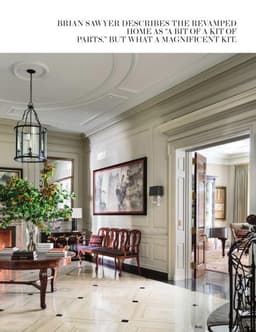 p.201
p.201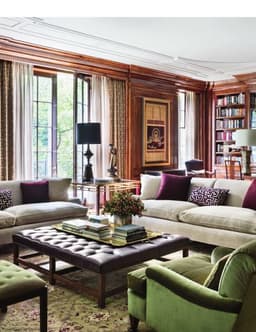 p.202
p.202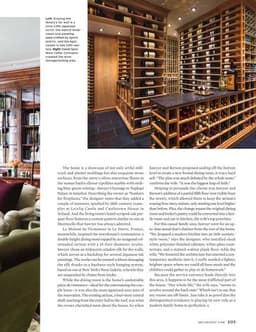 p.203
p.203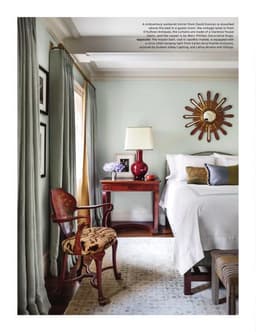 p.204
p.204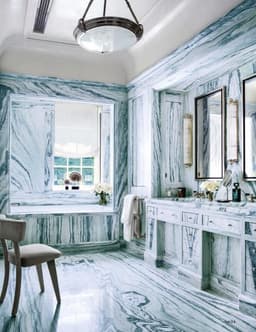 p.205
p.205Home Score
Radial Graph
The Space group dominates with Grandeur-driven elevation (5.0), while Story and Stage remain nearly identical (3.7 avg), with the pattern suppressed by modest Provenance (3.0) and Theatricality (3.0) that restrains what could otherwise be a more dramatically curated narrative.
Scoring Explanations
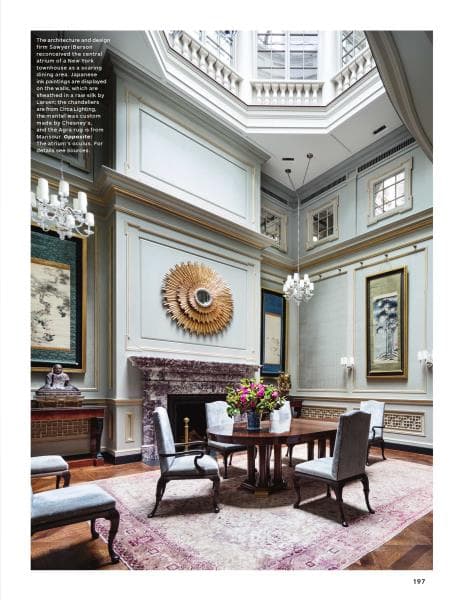
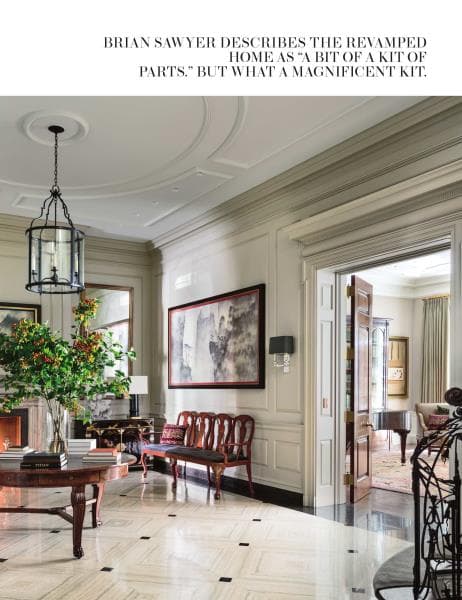
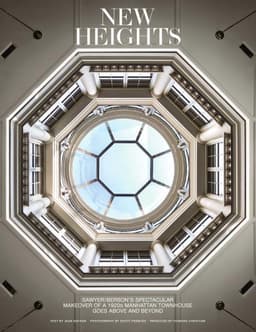
The octagonal atrium with skylight soaring four stories, marble entrance halls with black-and-white checkerboard floors, and the sheer scale of the 17,000-square-foot Federal-style townhouse with its columned dining room reaching to the cupola deliver unmistakable architectural dominance.
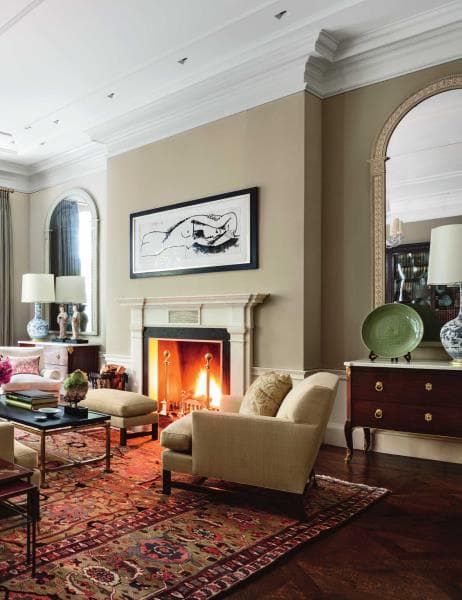
Despite the marble floors and stone surfaces in the entry and bath, the dominant experience is warm — walnut-paneled library, rich oriental rugs throughout, silk wall coverings, upholstered furniture, and dark wood floors create a predominantly warm tactile envelope.
Dense layering of Japanese scroll paintings, antique furnishings, oriental rugs, blue-and-white porcelain, sunburst mirrors, and collected objects across every room, all held in coherent dialogue by consistent color palettes and a blend of Asian and European decorative traditions.
Strong commitment to the 1920s Federal-style architecture with period-appropriate moldings, Empire library tables, circa-1790 Chinese lacquer settees, and 18th-century commodes, with only the modern kitchen insertion and contemporary silk wall coverings as deliberate modern intrusions.
Sawyer|Berson created a convincingly layered space that feels accumulated over time — mixing genuine antiques (18th-century examplars from Castle and Castletown House in Ireland) with the owner's Asian art collection — but the five-year renovation means everything was essentially placed at once.
The article describes a home reconceived for formal entertaining with the central atrium transformed into a grand dining area, multiple public rooms designed for flow, and the renovation driven by the need to host as a growing family — the public rooms clearly dominate the narrative.
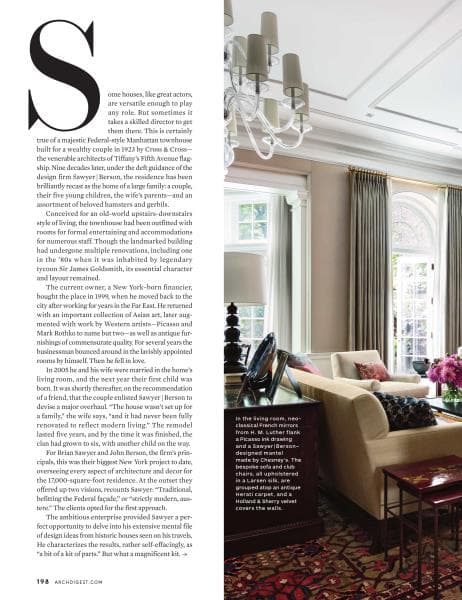
The marble entrance halls, formal dining atrium with chandelier, carefully arranged living room with Picasso ink drawing above the mantel, and the overall museum-quality presentation of Japanese paintings and antiques create spaces that enforce behavioral respect, though the article notes children and pets soften it.
Sawyer|Berson's hand is visible in every composed vignette — the symmetrical sofa arrangement in the library, the precisely hung Japanese scrolls flanking the sunburst mirror, and the styled sight lines through doorways — though the owner's genuine Asian art collection provides personal grounding.
The cipollino marble master bath is pure spectacle and the atrium cupola is an architectural statement, but the overall collection — Japanese paintings, antique furniture, Picasso and Rothko mentioned as personal acquisitions — serves a genuine collector's taste rather than brand-name broadcasting.