Homeowner Name
Steven Harris and Lucien Rees Roberts
About (information sourced from public biographical records)
Steven Harris and Lucien Rees Roberts run eponymous architecture and interior design firms; Harris teaches at Yale. Their Tribeca loft was featured in Architectural Digest in April 2014. Harris grew up upper-middle-class in Florida; Rees Roberts descends from three generations of British painters and studied at Cambridge.
Epstein Connection?
 DETECTIVE
 RESEARCHER
 EDITOR
Property Details
Wealth Score
5.0
/ 10
Wealth Source
MIXED
Steven Harris Architects LLP (founded 1985) and Rees Roberts + Partners; high-en…
Professional Category
ARCHITECTURE_DESIGN
Fame Score
5
4,104 wiki views
Board Memberships
Trustee, Saratoga Automobile Museum; Unknown (legacy text), Steven Harris: Trustee of the Saratoga Automobile Museum; Professor (25+ years); established Steven Harris and Lucien Rees-Roberts Scholarship Fund, Yale University School of Architecture; Unknown (legacy text), Steven Harris: Professor of Architecture at Yale University (25+ years); established the Steven Harris and Lucien Rees-Roberts Scholarship Fund at Yale School of Architecture. Lucien Rees Roberts: Co-chair for benefit events for The Sylvia Center.
Influence Score
—
Architectural Digest Issue:
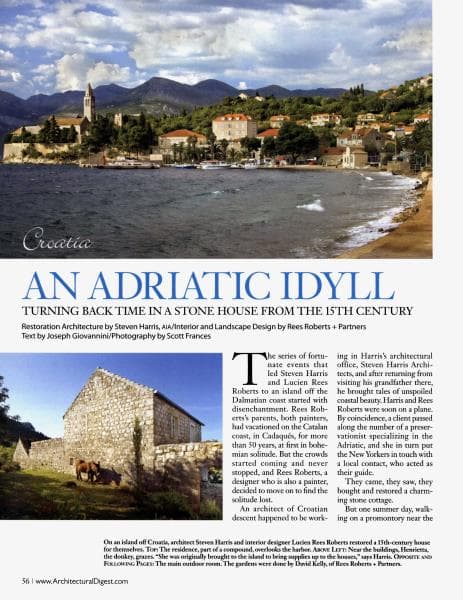
“an adriatic idyll”
by Joseph Giovannini
Connection Summary (Created by Opus 4.5 based on all evidence collected)
Investigation identified Steven Harris and Lucien Rees Roberts as an architectural firm partnership, not individual subjects, with DOJ records referencing a different "Harris Sam" in academic contexts. No confirmed connection exists between the architectural practice Steven Harris Architects / Rees Roberts + Partners and Jeffrey Epstein.
DOJ Documents
2,437
results in Epstein Library
Evidence Sources
2
Black Book + DOJ Library
Evidence Entries
0
distinct pieces
Confidence
0%
pipeline certainty
Connection Evidence
The following documents were used as direct evidence of a possible connection for the Researcher and Editor to make an assessment:
Agentic AI Reasoning Logic

Researcher’s Assessment: COINCIDENCE
The AD feature identifies Steven Harris and Lucien Rees Roberts as an architecture firm (Steven Harris Architects / Rees Roberts + Partners) designing a Croatian property restoration project. This is a non-person entity (architectural practice/firm), not individuals. The DOJ 'Steven Harris' results reference 'Harris Sam' in academic/intellectual contexts, not the architect. The Black Book 'Roberts' match is last-name-only with no first name confirmation, insufficient to connect these architects to Epstein.
Reviewed 2/21/2026

Editor’s Final Judgement: REJECTED
Auto-rejected: triaged as COINCIDENCE — The AD feature identifies Steven Harris and Lucien Rees Roberts as an architecture firm (Steven Harris Architects / Rees Roberts + Partners) designing a Croatian property restoration project. This is a non-person entity (architectural practice/firm), not individuals. The DOJ 'Steven Harris' results reference 'Harris Sam' in academic/intellectual contexts, not the architect. The Black Book 'Roberts' match is last-name-only with no first name confirmation, insufficient to connect these architects to Epstein.
Reviewed 2/21/2026
Home Score Summary (Custom Aesthetic Scoring Instrument v2.3)
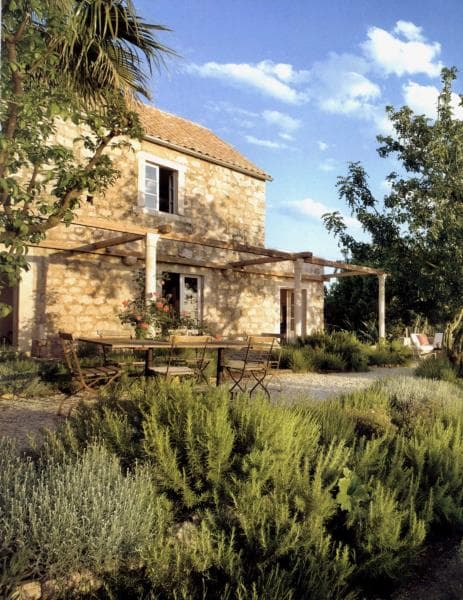
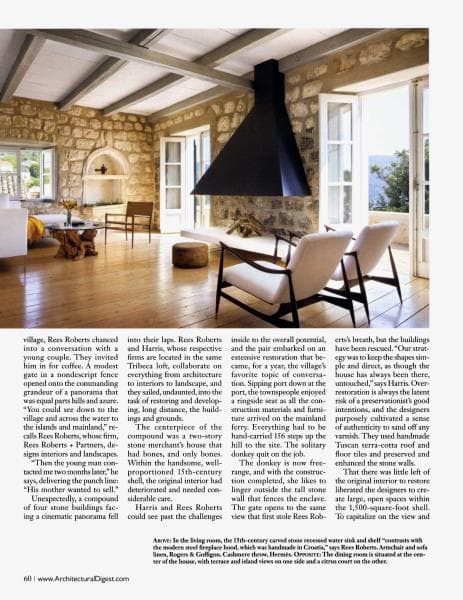
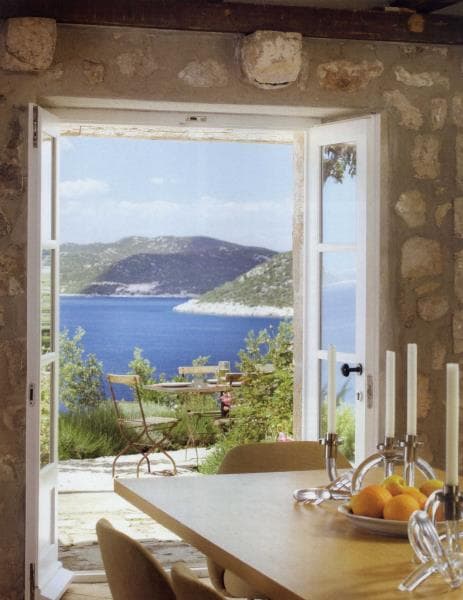
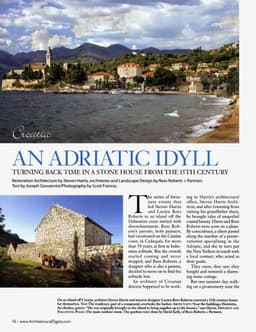
A 15th-century Dalmatian stone compound stripped to its bones and furnished with surgical precision — three pedigreed Modernist chairs against five centuries of patina. The restraint is the statement: 156 steps up a hill with no road, no crowd, just rosemary, stone, and the Adriatic. Two designers building their own escape, where the architecture's age does all the talking and the contemporary furniture knows when to shut up.
Feature Pages
 p.56
p.56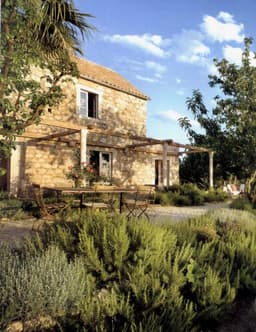 p.57
p.57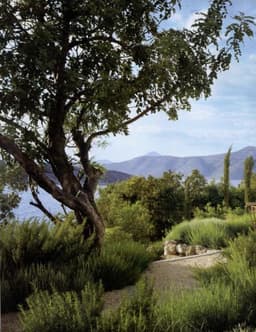 p.58
p.58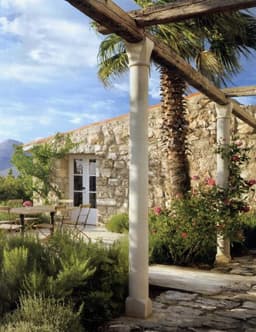 p.59
p.59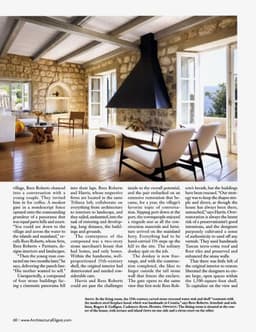 p.60
p.60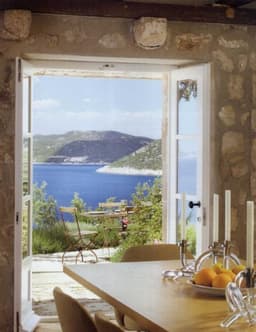 p.61
p.61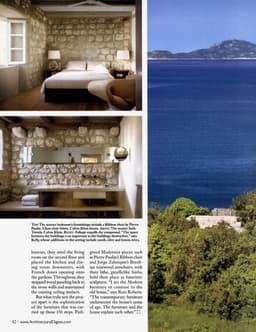 p.62
p.62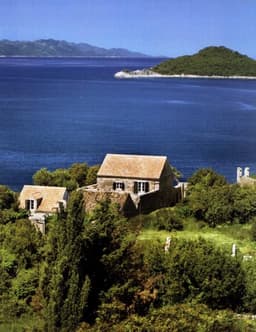 p.63
p.63Home Score
Radial Graph
Space is suppressed by austere Material Warmth paired with aggressive Maximalism rejection, Story is anchored by high Historicism and Provenance but gutted by minimal Hospitality, and Stage diverges through dominant Curation that overrides subdued Formality and Theatricality—creating a profile where historical authentication and curatorial restraint dominate over spatial generosity or performative welcome.
Scoring Explanations
The 15th-century stone compound has substantial masonry construction and generous proportions, but the rooms are human-scaled — a 1,500-square-foot shell with modest ceiling heights, not palatial volumes.
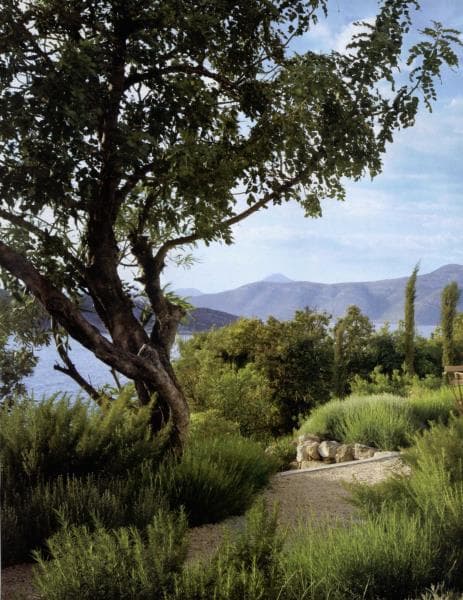
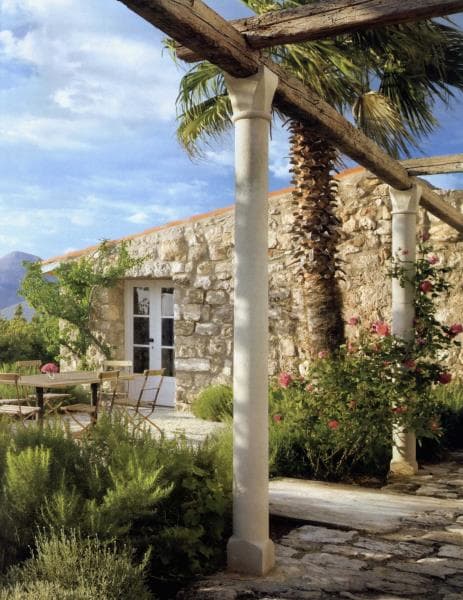
Exposed rough-cut stone walls, ancient timber ceiling beams, terracotta roof tiles, handmade Tuscan terra-cotta floor tiles, linen textiles, and Mediterranean plantings of rosemary and lavender create an entirely tactile, natural material palette.
The interiors are remarkably spare — the living room holds a single suspended fireplace, two chairs, and little else; the bedroom is just a bed against stone walls; the strategy was deliberate restraint to let the ancient shell speak.
The 15th-century stone structure was preserved with its original walls, ceiling timbers, and carved stone sink intact, with the deliberate introduction of Modernist furniture (Pierre Paulin Ribbon chair, Jorge Zalszupin rosewood armchairs) as a conscious contrast rather than an anachronism.
The building itself carries genuine 500-year-old patina — original stone walls, weathered timber, the carved stone sink — and the article notes they purposely cultivated a sense of authenticity, stripping paneling back to expose original surfaces rather than refinishing them.
This is a personal retreat on a remote Dalmatian island reached by 156 hand-carried steps with no road access — the article describes it as a place born from seeking solitude, with a small 1,500-square-foot interior designed for the couple, not entertaining.
Despite the pedigreed Modernist furniture, the worn stone floors, outdoor dining terrace with simple folding chairs, and open French doors to the garden create a relaxed Mediterranean informality where you'd walk barefoot.
Two prominent New York design professionals (an architect and an interior/landscape designer) carefully selected pedigreed Modernist pieces — Paulin's Ribbon chair, Zalszupin's Brazilian rosewood armchairs — as deliberate sculptural counterpoints to the ancient shell, a highly composed editorial strategy.
The designer furniture is recognizable to insiders but the overall gesture is one of restraint and understatement — wealth expressed through what was removed rather than what was added, on a remote island with no audience to perform for.
Analysis
AD Appearance
CollapseIssue
8/2009
Notes
{"source": "reextract_v2", "page_range": "56,57,58,59,60,61,62,63", "section": "Exotic Homes", "genre": "article", "spread_pages": [56, 57, 58, 59, 60, 61, 62, 63], "spread_page_count": 8}
Location
None, Dalmatia
Design Style
15th-century Dalmatian stone restoration with Modernist furnishings
Article Title
AN ADRIATIC IDYLL
Square Footage
1500
Architecture Firm
Steven Harris Architects / Rees Roberts + Partners
Key Findings
Expand