Homeowner Name
Dean Marchetto
About (information sourced from public biographical records)
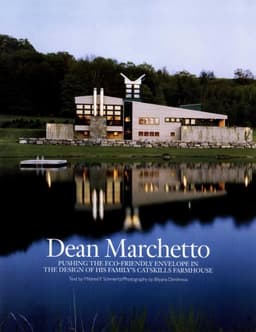
Dean Marchetto is founding principal of MHS Architecture, a major transit-oriented development firm. His September 2007 Architectural Digest feature presented his family's eco-friendly Catskills farmhouse. He grew up in North Bergen, New Jersey, as the son of a contractor and built his firm from a single 25-unit Hoboken project in 1981.
Epstein Connection?
 DETECTIVE
 RESEARCHER
 EDITOR
Property Details
Wealth Score
7.0
/ 10
Wealth Source
SELF MADE
Founding principal of MHS Architecture (formerly Marchetto Higgins Stieve Archit…
Professional Category
ARCHITECTURE_DESIGN
Fame Score
1
Board Memberships
Unknown (legacy text), Hoboken Historical Museum (donated architectural design services for the museum's home); Member and Former Chairman, Hudson County Construction Board of Appeals; Member, Hudson County Public Arts Commission; Fellow (FAIA), American Institute of Architects College of Fellows; Unknown (legacy text), Hudson County Construction Board of Appeals (member and former chairman); Hudson County Public Arts Commission (member); Fellow of the American Institute of Architects (FAIA, 2016); Active member of Urban Land Institute (ULI) and Congress for the New Urbanism (CNU)
Influence Score
—
Architectural Digest Issue:
“dean marchetto”
by Mildred F. Schmertz
Home Score Summary (Custom Aesthetic Scoring Instrument v2.3)
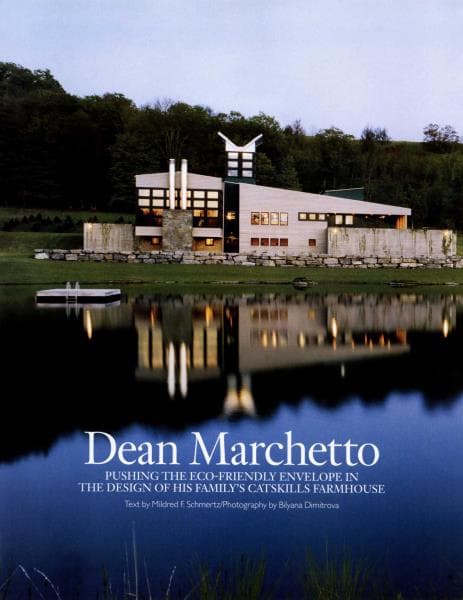
An architect's principled rural retreat where ecological conscience and Arts and Crafts warmth merge inside a rehabilitated Catskills dairy farm. The barn's weathered bones give the project an honesty that no amount of new construction could fake. Oak, stone, and old timber do all the talking — nothing here performs for anyone but the family that lives in it.
Feature Pages
 p.294
p.294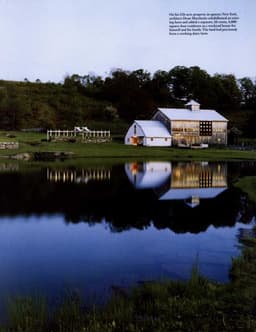 p.295
p.295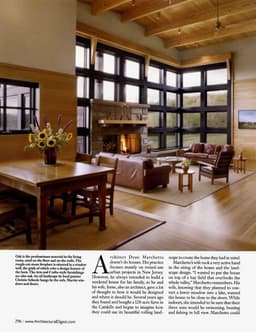 p.296
p.296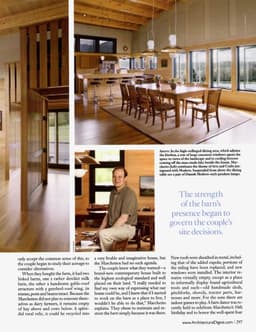 p.297
p.297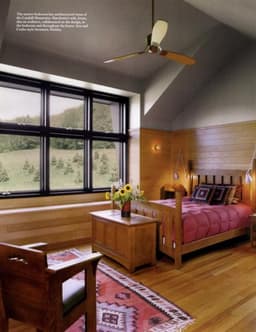 p.298
p.298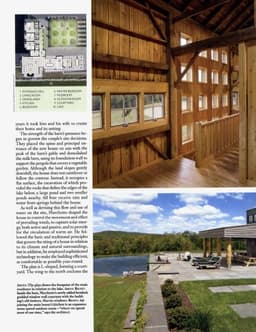 p.299
p.299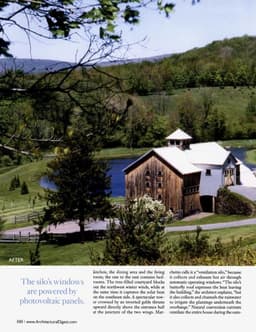 p.300
p.300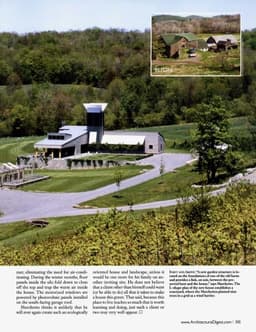 p.301
p.301Home Score
Radial Graph
Stage's severe suppression (1.3) dominates the pattern, driven by minimal Formality and Theatricality, while Space's Material Warmth (5) and Story's Provenance (4) create pockets of substance that cannot overcome the home's resistance to visual performance or curatorial gesturing.
Scoring Explanations
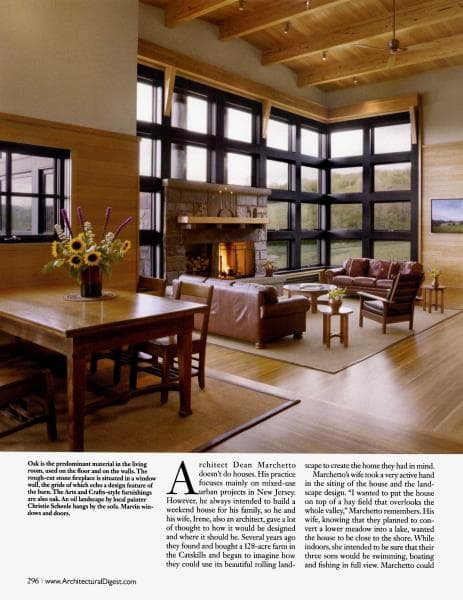
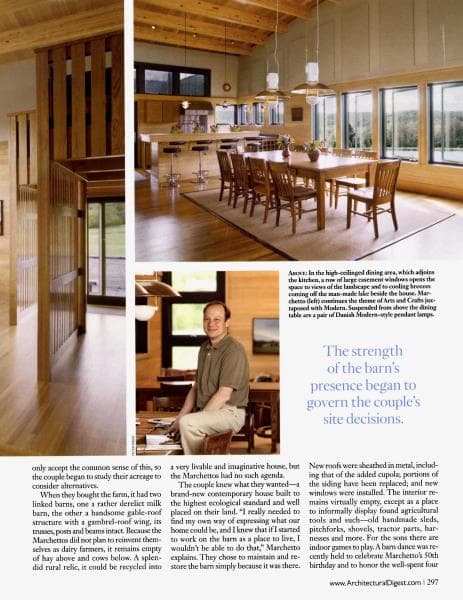
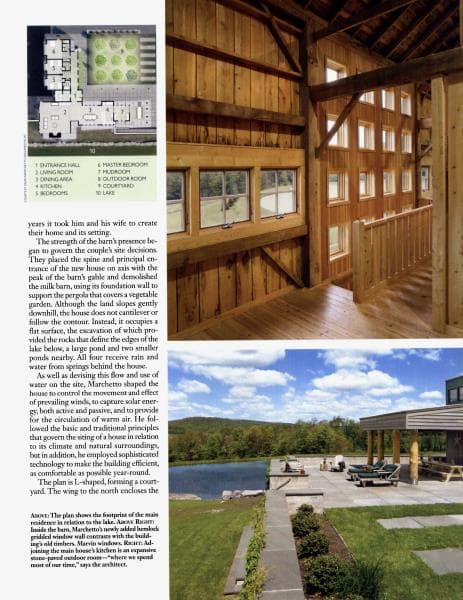
The high-ceilinged dining area with large casement windows and the double-height living room with massive stone fireplace wall create generous proportions, but the overall scale remains residential and grounded rather than imposing.
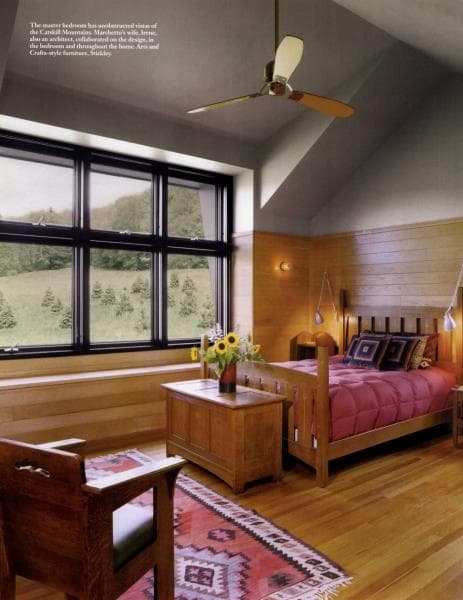
Oak predominates on floors, walls, and ceilings throughout; Arts and Crafts Stickley furniture, leather seating, woven rugs, and a rough-cut stone fireplace create an enveloping tactile warmth with virtually no cold or glossy surfaces.
Rooms are restrained and relatively spare — the dining area has a simple table and pendant lamps, the living room features a few key furniture pieces, and the barn interior is virtually empty; objects have breathing room.
The Arts and Crafts furniture by Stickley and the rehabilitated barn structure reference early 20th-century agrarian and craft traditions, but the contemporary architecture, photovoltaic panels, and modern window systems create deliberate anachronism.
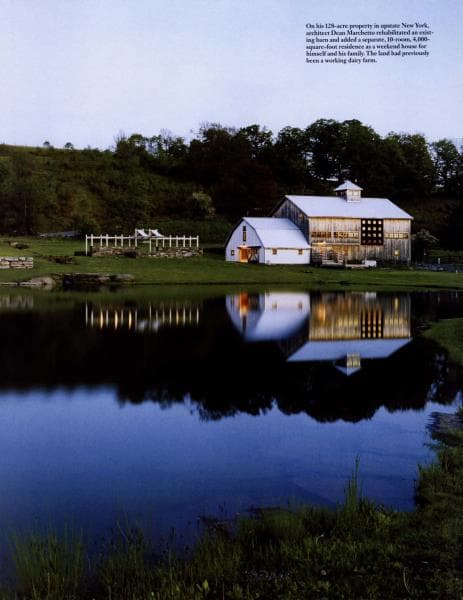
The property was a working dairy farm with existing barns that the Marchettos preserved and rehabilitated rather than demolished; the old timbers, weathered barn siding, and agricultural tools displayed inside convey genuine accumulated age.
The article describes a family weekend house designed for the Marchettos and their three sons to swim, boat, and fish — it's fundamentally a private retreat, with the outdoor room described as 'where we spend most of our time.'
This is a farmhouse designed for a family with three active boys — curl-up leather sofas, kilim rugs on oak floors, a pink comforter on the bed, and indoor games in the barn all signal deep informality and lived-in comfort.
Dean Marchetto and his wife Irene, both architects, designed everything themselves for their own family's use; the Arts and Crafts furniture and folk-art rug choices feel personally driven rather than editorially styled.
The eco-friendly technologies (photovoltaic panels, ventilation silo, passive solar design) serve function not display; there are no brand-name statements, no recognizable art, and the wealth is channeled into land, sustainability, and craft rather than performance.