Homeowner Name
Landgrave Moritz of Hesse
About (information sourced from public biographical records)
Landgrave Moritz of Hesse (1926-2013) headed the House of Hesse and managed family estates through the Hessische Hausstiftung. Architectural Digest featured Hesse properties in April 2006. Born into one of Europe's oldest noble families tracing to the 13th century, he inherited vast estates, art collections, and business interests.
Epstein Connection?
 DETECTIVE
 RESEARCHER
 EDITOR
Property Details
Wealth Score
2.0
/ 10
Wealth Source
OLD MONEY
Inherited aristocratic estates, castles, art collections, agricultural holdings,…
Professional Category
ROYALTY
Fame Score
4
531,294 wiki views
Board Memberships
Unknown (legacy text), Head of the Hessische Hausstiftung, which oversees the family's art collections at Schloss Wolfsgarten and Schloss Fasanerie; loaned princely treasures to major international museum exhibitions; Chairman / Managing Director, Hessische Hausstiftung (Hessian House Foundation); Founder / Board Member, Cultural Foundation of the House of Hesse; Unknown (legacy text), Chairman/Managing Director of the Hessische Hausstiftung (Hessian House Foundation); Founder/Board Member of the Cultural Foundation of the House of Hesse; supporter of the Kronberg Academy (international chamber music academy) and the Institute for New Technical Form in Darmstadt
Influence Score
—
Architectural Digest Issue:
“germany's house of hesse”
by Wendy Moonan
Home Score Summary (Custom Aesthetic Scoring Instrument v2.3)
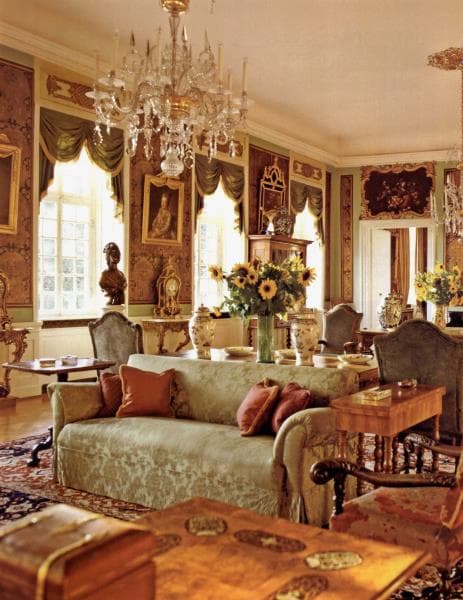
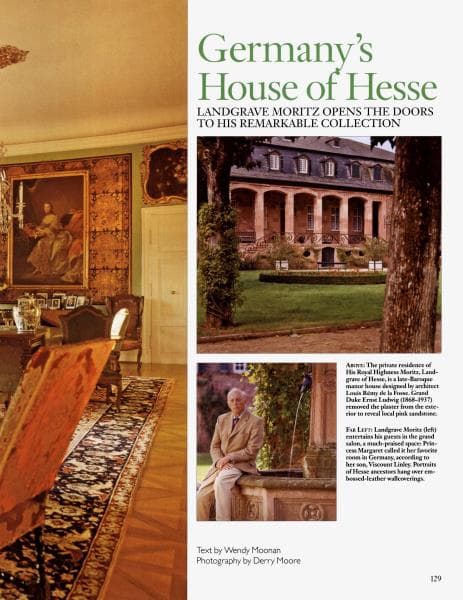
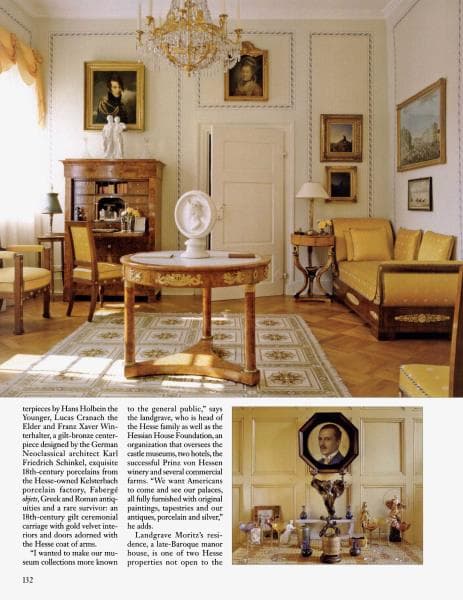
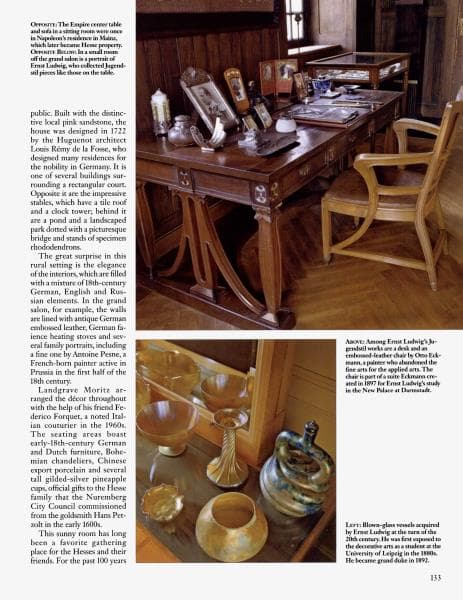
A genuine aristocratic accumulation where centuries of Hessian dynastic life have deposited themselves across embossed leather walls and Brussels tapestries without ever being 'designed.' The pink sandstone Baroque manor feels like a living museum that happens to still have someone sleeping in it — Cranach portraits watching over blown-glass Jugendstil vessels, gilded-silver pineapple cups from Nuremberg beside Chinese export porcelain. This is provenance you cannot buy.
Feature Pages
 p.128
p.128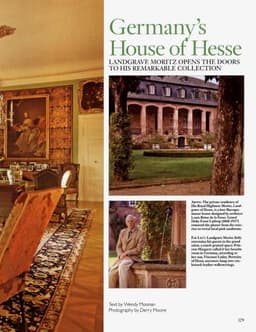 p.129
p.129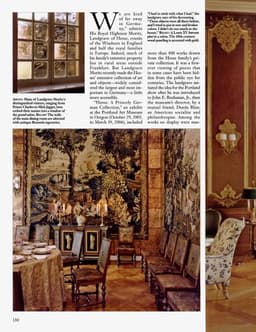 p.130
p.130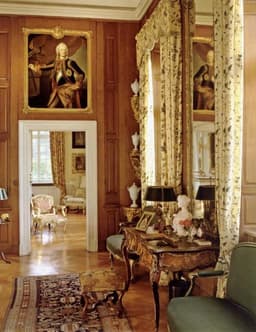 p.131
p.131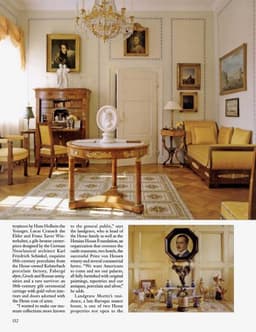 p.132
p.132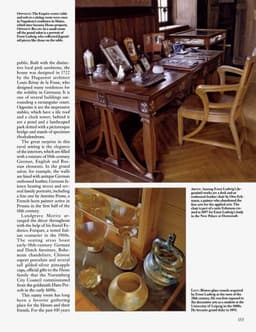 p.133
p.133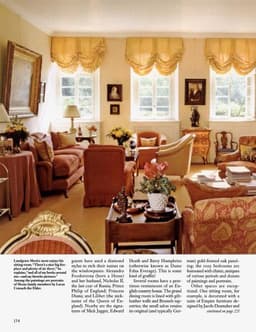 p.134
p.134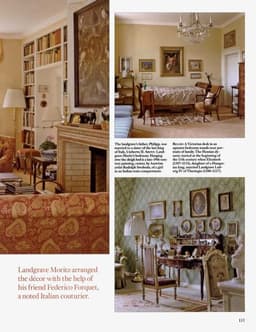 p.135
p.135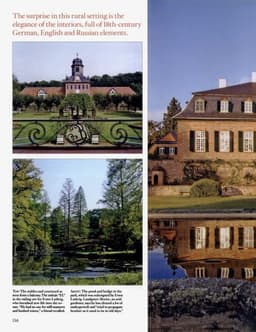 p.136
p.136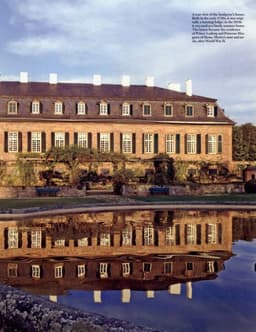 p.137
p.137Home Score
Radial Graph
The spatial and narrative dimensions dominate equally at 4.7, driven by high Grandeur, Maximalism, and Historicism paired with exceptional Provenance, while the Stage group collapses to 2.7 due to suppressed Theatricality despite moderate Formality, creating a pattern where accumulated authenticity and dynastic depth dramatically outweigh any performative or curatorial intent.
Scoring Explanations
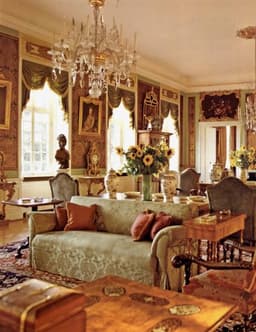
The grand salon features soaring ceilings, crystal chandeliers, embossed leather wall coverings, gilt-framed portraits, and the overall scale of this late-Baroque manor house with its parade of formal rooms is unmistakably palatial.
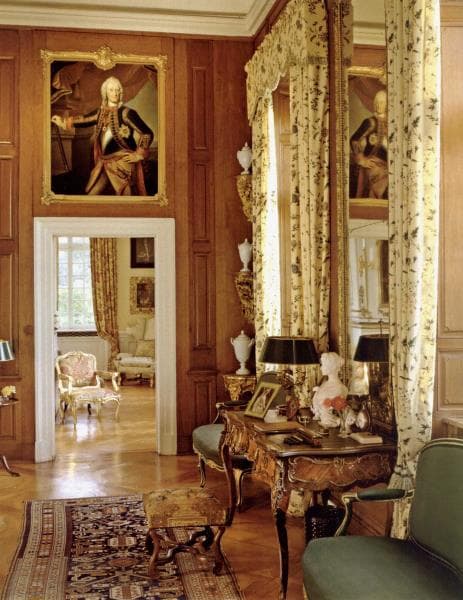
Warm wood paneling, embossed leather walls, oriental rugs, damask upholstery, and rich textile draperies dominate throughout, balanced only by the coolness of the crystal chandeliers and porcelain collections.
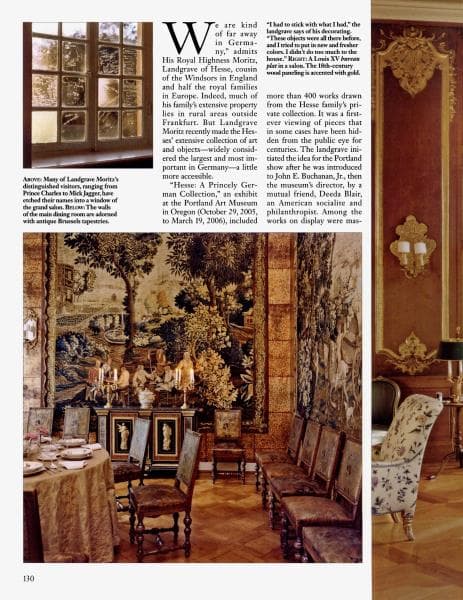
Every surface is activated — embossed leather walls, layered tapestries, Brussels tapestries in the dining room, Chinese export porcelain, gilded-silver pineapple cups, Bohemian chandeliers, and portraits in every room — yet everything is in dialogue within a consistent 18th-century vocabulary.
The interiors commit fully to 18th-century German, English, and Russian elements with period-appropriate furniture, original wood paneling, and no visible anachronisms; this is a genuine historical residence, not a revival.
This is genuine multi-generational accumulation — the Hesse dynasty's collection spans centuries, with family portraits by Lucas Cranach the Elder, Fabergé pieces, Kelsterbach porcelain from the family's own factory, and guests etching their names into windowpanes over the past 100 years.
The article describes the grand salon as a long-time favorite gathering place where Princess Margaret called it her favorite room in Germany, distinguished visitors from Prince Charles to Mick Jagger have etched names into windows, and the public rooms clearly dominate the private ones.
The grand salon and dining room with their embossed leather walls, tapestries, and gilt furnishings enforce considerable behavioral rules, though the sitting room with its softer furnishings, books, and Moritz's personal retreat suggest these rooms are genuinely lived in rather than purely ceremonial.
Federico Forquet, a noted Italian couturier, helped arrange the décor in the 1960s, but the underlying collection is deeply personal and inherited — the professional touch organized generations of family possessions rather than creating an editorial tableau from scratch.
Nothing here performs for an outside audience — this is inherited wealth accumulated over centuries by a dynasty that predates the concept of lifestyle branding; the Old Masters, Fabergé, and Cranach paintings are family heirlooms, not status purchases.