Homeowner Name
Barbara Riley Levin and Gerald M. Levin
About (information sourced from public biographical records)
Gerald M. Levin was CEO and Chairman of Time Warner who orchestrated the AOL-Time Warner merger. Architectural Digest featured the Levins' New York home in May 2002. Gerald joined HBO in 1972 under Charles Dolan and rose through Time Warner's ranks; no family wealth is documented.
Epstein Connection?
 DETECTIVE
 RESEARCHER
 EDITOR
Property Details
Wealth Score
8.0
/ 10
Wealth Source
SELF MADE
Career as CEO and Chairman of Time Warner Inc., orchestrating major media merger…
Professional Category
MEDIA
Fame Score
7
152,337 wiki views
Board Memberships
Trustee Emeritus, The Museum of Jewish Heritage—A Living Memorial to the Holocaust; Board Member, National Cable Television Center and Museum; Board Member and Treasurer, New York Philharmonic; Chairman of the Board, Haverford College; Trustee Emeritus, Hampshire College; Director, New York Stock Exchange; Director, New York Federal Reserve Bank; Member, Council on Foreign Relations; Member, The Trilateral Commission; Member, Economic Club of New York
Influence Score
—
Architectural Digest Issue:
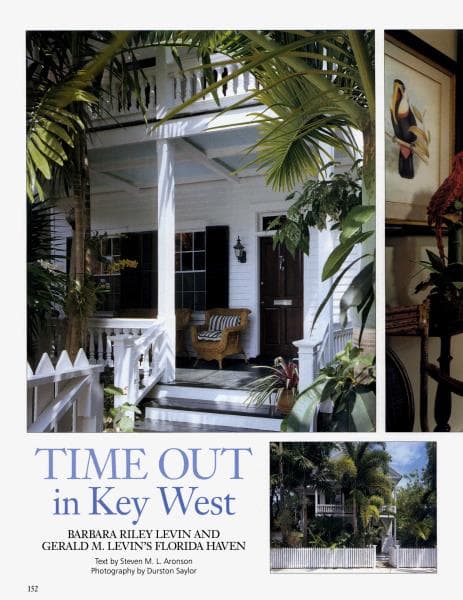
“time out in key west”
by Steven M. L. Aronson
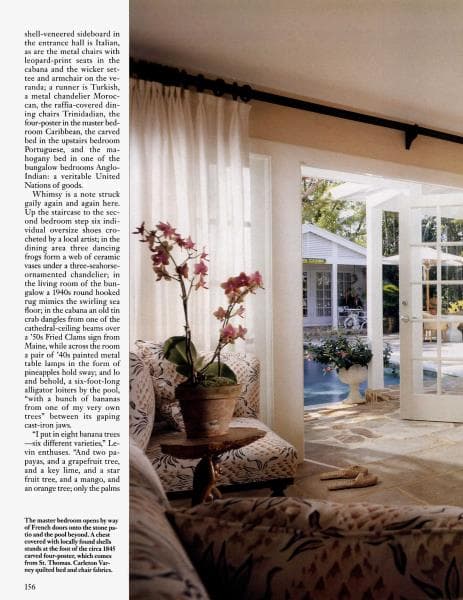
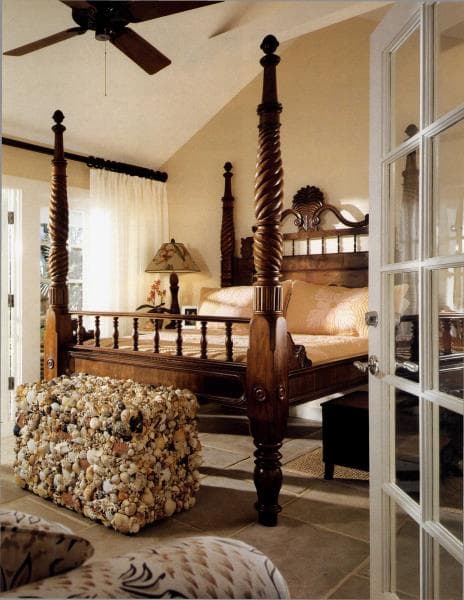
Connection Summary (Created by Opus 4.5 based on all evidence collected)
Investigation revealed references to Barbara Riley Levin and Gerald M. Levin stem from a historic real estate article about a Key West property, not personal connections to Epstein. DOJ search results contained only unrelated law firm references and financial disputes involving the surname "Levin," with no confirmed connection between the Levins and Jeffrey Epstein.
DOJ Documents
634
results in Epstein Library
Evidence Sources
1
DOJ Library
Evidence Entries
0
distinct pieces
Confidence
0%
pipeline certainty
Connection Evidence
The following documents were used as direct evidence of a possible connection for the Researcher and Editor to make an assessment:
Agentic AI Reasoning Logic

Researcher’s Assessment: COINCIDENCE
The AD feature references a 1899-built historic property in Key West with homeowners Barbara Riley Levin and Gerald M. Levin. This is a historic retrospective article about a real estate property, not evidence of personal connection to Epstein. The DOJ results show only law firm references (Mintz Levin) and unrelated financial disputes mentioning 'Levin' as a surname — no connection to the homeowners. No Black Book match exists.
Reviewed 2/21/2026

Editor’s Final Judgement: REJECTED
Auto-rejected: triaged as COINCIDENCE — The AD feature references a 1899-built historic property in Key West with homeowners Barbara Riley Levin and Gerald M. Levin. This is a historic retrospective article about a real estate property, not evidence of personal connection to Epstein. The DOJ results show only law firm references (Mintz Levin) and unrelated financial disputes mentioning 'Levin' as a surname — no connection to the homeowners. No Black Book match exists.
Reviewed 2/21/2026
Home Score Summary (Custom Aesthetic Scoring Instrument v2.3)
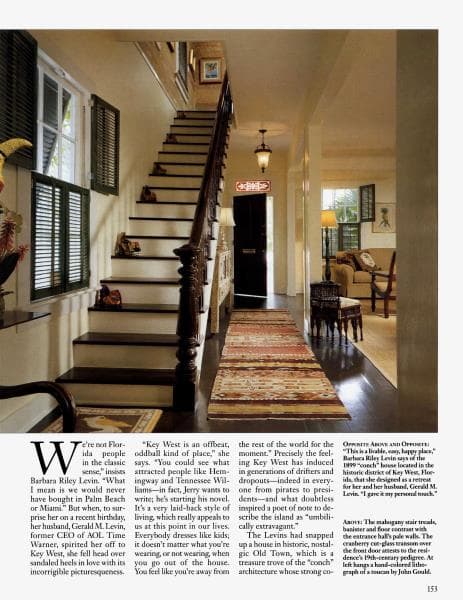
A former decorator's personal tropical fantasy assembled from global bazaars — Trinidadian dining chairs, a Portuguese carved bed, Turkish runners, Audubon engravings — all woven into an 1899 Key West conch house with the discipline of someone who knows the rules and the freedom of someone on permanent vacation. The whimsy is deliberate (dancing ceramic frogs, a six-foot cast-iron alligator by the pool) but never precious, grounded by sisal, wicker, and the barefoot casualness Key West demands.
Feature Pages
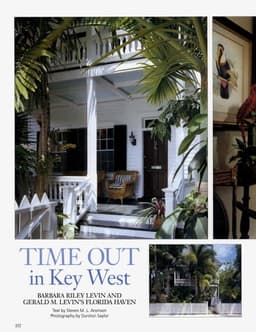 p.152
p.152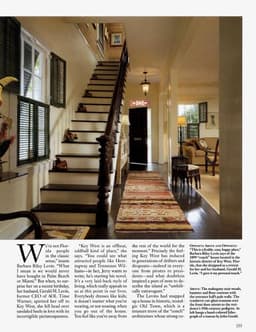 p.153
p.153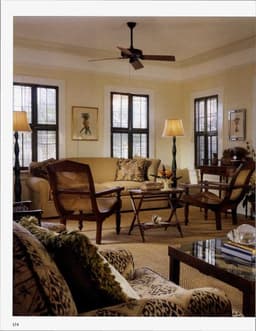 p.154
p.154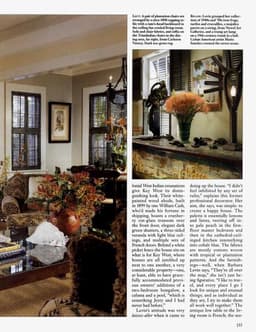 p.155
p.155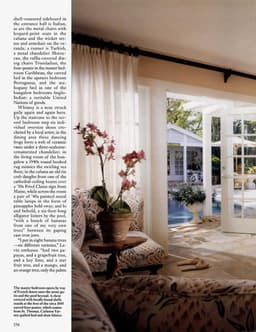 p.156
p.156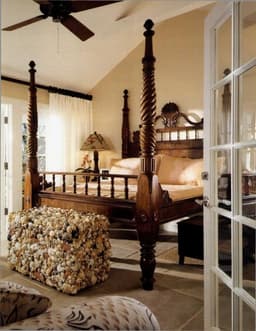 p.157
p.157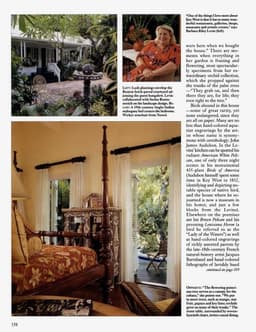 p.158
p.158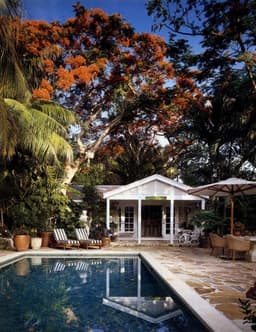 p.159
p.159Home Score
Radial Graph
Space dominates with Material Warmth and Maximalism balancing Grandeur's restraint, Story maintains equilibrium across historical narrative and lived experience, and Stage suppresses across all dimensions—driven by notably low Formality and Theatricality that resist the curation scores slightly above them.
Scoring Explanations
A modest-scaled 1899 white-painted wood 'conch' house with standard ceiling heights, a three-sided veranda, and cathedral ceilings only in the kitchen — charming but human-scale residential architecture throughout.
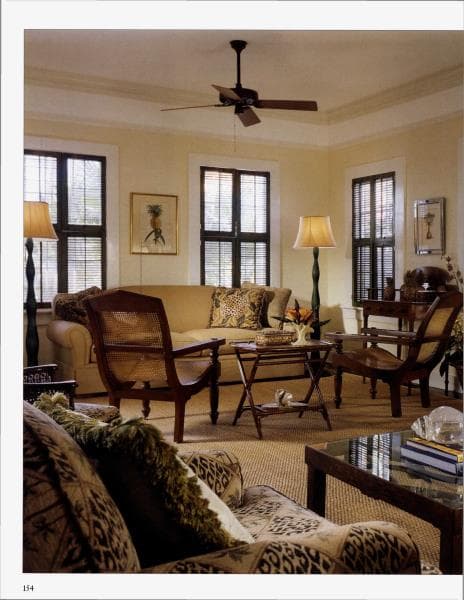
Dominated by dark mahogany furniture, wicker, rattan, sisal rugs, linen curtains, cane-backed seating, and tropical fabrics in cottons with plantation patterns — overwhelmingly tactile and warm with only stone patio floors as a cooler counterpoint.
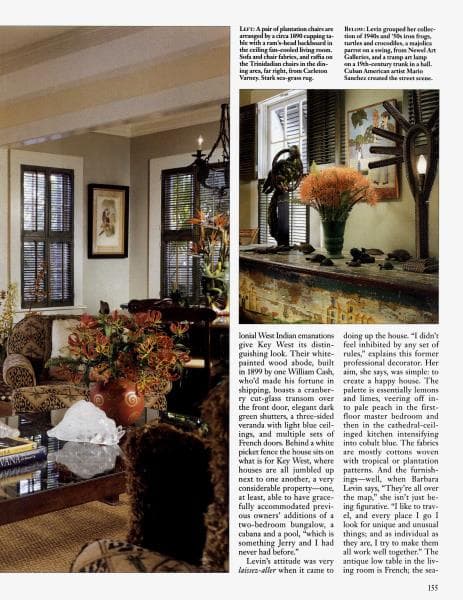
Dense layering of Audubon engravings, shell-covered chests, iron frogs, ceramic vases, orchids, leopard-print fabrics, Trinidadian chairs, and hand-colored lithographs — all in coherent tropical-colonial dialogue with consistent warm tones and natural materials.
Strong commitment to Caribbean colonial and West Indian aesthetics with the circa 1845 carved four-poster from St. Thomas, 19th-century Anglo-Indian mahogany bed, Moroccan chandelier, and period-appropriate shutters and transom — the ceiling fan is the only modern concession visible.
Barbara Levin describes traveling widely to collect unique pieces — the Turkish runner, Trinidadian chairs, Caribbean four-poster, Portuguese carved bed — assembled with a convincing 'been here forever' quality, but it's clearly a curated assemblage for a recently purchased retreat rather than generations of accumulation.
The pool, cabana, veranda with wicker settee, and outdoor dining area suggest entertaining capacity, but the article frames this as a personal retreat — a 'time out' — with the bungalow, cabana, and pool described as additions for the couple's own enjoyment rather than for hosting.
The article explicitly describes the Key West ethos of sandaled heels, 'everybody dresses like kids,' and not caring what you wear — the wicker, sisal, and curl-up tropical furniture all reinforce a barefoot-casual atmosphere despite the quality of furnishings.
Barbara Levin is described as a 'former professional decorator' who designed it herself with a 'personal touch,' collaborating with Stefan Steil on landscape — the vignettes are composed but reflect genuine personal collecting rather than editorial staging, with Carleton Varney fabrics and Newel Art Galleries pieces chosen by the owner herself.
The Audubon prints (including a rare American White Pelican from the 455-plate Birds of America) and the 1845 Caribbean four-poster are genuinely valuable but displayed for personal pleasure rather than performance — the shell-covered chest and dancing iron frogs signal whimsy over wealth signaling.
Analysis
AD Appearance
CollapseIssue
3/2003
Notes
{"social_circle": "Article references Key West's historical attraction for Hemingway and Tennessee Williams, and mentions Jerry (Gerald) Levin wanting to write and start his next novel there", "previous_owners": ["William Cash"], "spread_pages": [152, 153, 154, 155, 156, 157, 158, 159], "spread_page_count": 8}
Location
Key West, Florida
Year Built
1899
Design Style
Caribbean colonial / West Indian tropical with eclectic global accents
Article Title
TIME OUT in Key West
Key Findings
Expand