Homeowner Name
Ray and Sylvia Jacobs
About (information sourced from public biographical records)
Ray and Sylvia Jacobs were featured in Architectural Digest in December 2002 for their Los Angeles home.
Epstein Connection?
 DETECTIVE
 RESEARCHER
 EDITOR
Property Details
Wealth Score
—
Wealth Source
UNKNOWN
Unknown; categorized as 'Business' by Architectural Digest
Professional Category
BUSINESS
Fame Score
5
15,236 wiki views
Board Memberships
—
Influence Score
—
Architectural Digest Issue:
“up the down staircase”
by Peter Haldeman
Connection Summary (Created by Opus 4.5 based on all evidence collected)
Investigation identified surname matches in DOJ records referring to different individuals ("lunatique jacobs" and "Alice Jacobs") with different first names than Ray and Sylvia Jacobs. No confirmed connection between Ray and Sylvia Jacobs and Jeffrey Epstein was established.
DOJ Documents
697
results in Epstein Library
Evidence Sources
1
DOJ Library
Evidence Entries
0
distinct pieces
Confidence
0%
pipeline certainty
Connection Evidence
The following documents were used as direct evidence of a possible connection for the Researcher and Editor to make an assessment:
Agentic AI Reasoning Logic

Researcher’s Assessment: COINCIDENCE
The DOJ results reference 'lunatique jacobs' and 'Alice Jacobs' — different individuals with different first names than 'Ray and Sylvia Jacobs.' The AD feature is a 2012 architecture article about a residential home design, which is a non-person entity (property). No Black Book match exists for Ray and Sylvia Jacobs.
Reviewed 2/22/2026

Editor’s Final Judgement: REJECTED
Auto-rejected: triaged as COINCIDENCE — The DOJ results reference 'lunatique jacobs' and 'Alice Jacobs' — different individuals with different first names than 'Ray and Sylvia Jacobs.' The AD feature is a 2012 architecture article about a residential home design, which is a non-person entity (property). No Black Book match exists for Ray and Sylvia Jacobs.
Reviewed 2/23/2026
Home Score Summary (Custom Aesthetic Scoring Instrument v2.3)
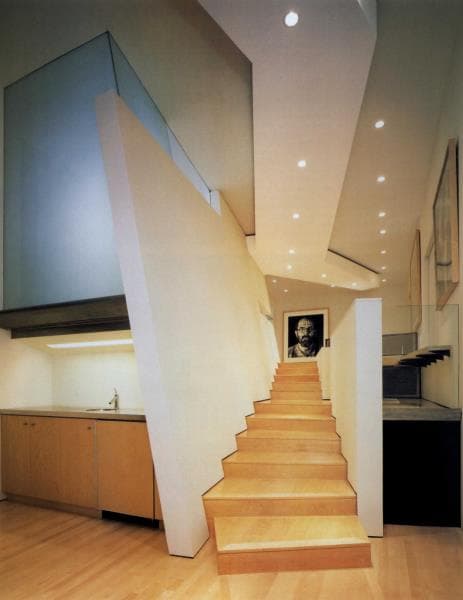
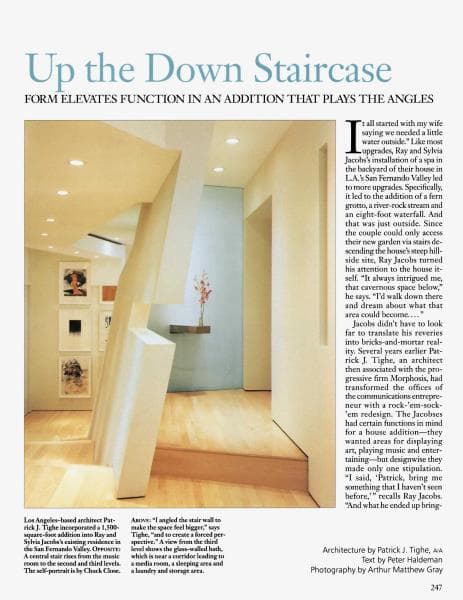
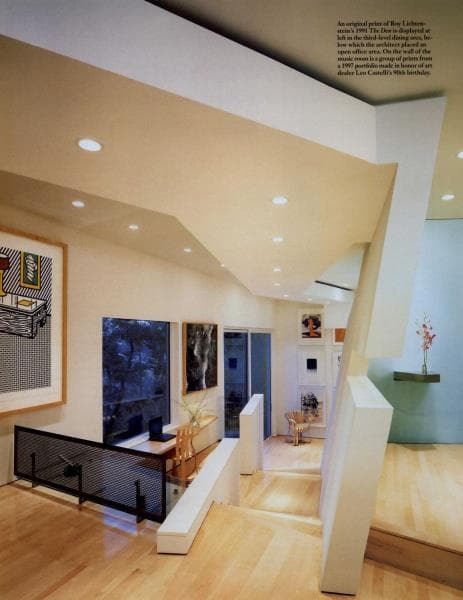
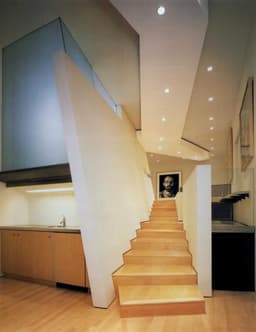
A deconstructivist jewel box where the architecture performs as aggressively as the blue-chip art it houses. Tighe's angled planes and floating glass volumes channel Morphosis DNA into a space that treats the staircase as sculpture and every sight line as a gallery composition. The warmth of blonde maple barely domesticates what is essentially a private kunsthalle built into a San Fernando Valley hillside.
Feature Pages
 p.246
p.246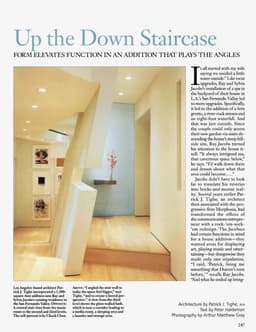 p.247
p.247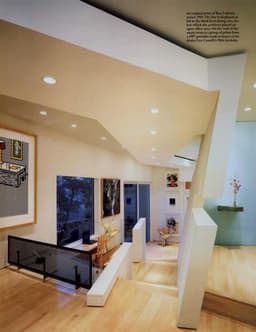 p.248
p.248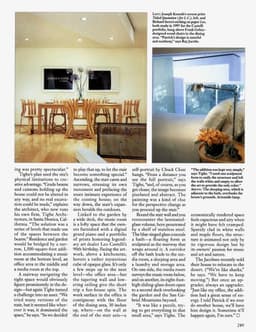 p.249
p.249Home Score
Radial Graph
The score pattern reflects suppressed historical narrative (Story at 1.7) against dominant curatorial theatricality (Stage at 3.3, driven by high Curation), with Space (3.0) balanced between Grandeur and restrained Warmth, indicating a residence engineered as exhibition vessel rather than contextual dwelling.
Scoring Explanations
The double-height ceilings, angled architectural planes, and dramatic staircase cutting through the volume create impressive spatial presence that goes well beyond standard residential scale.
Balanced tension between the warm blonde maple floors and stair treads and the cool white walls and angular plaster surfaces, with the wood providing substantial warmth against the gallery-like architecture.
The spaces are restrained with breathing room between carefully placed artworks; the architecture itself is the primary visual event, with only select pieces of art and furniture punctuating the volumes.
Purely contemporary deconstructivist architecture with no historical references whatsoever — the angled walls, floating glass volumes, and Morphosis-influenced geometry are emphatically of their moment.
Everything is new construction with pristine finishes; the 1,500-square-foot addition was purpose-built, and while the art collection has significance (Lichtenstein, Chuck Close, Kosuth, Serra), nothing reads as inherited or accumulated over generations.
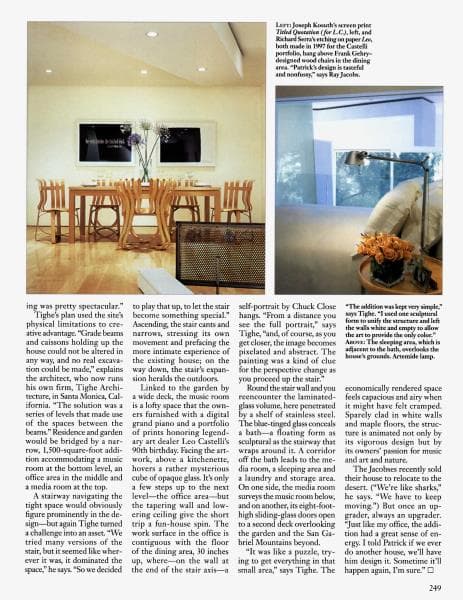
The article describes areas for displaying art, playing music, and entertaining as key functions, with the music room, media room, and dining area serving social purposes, but the spaces also feel deeply personal with the private sleeping area and office.
The gallery-quality art and pristine architectural surfaces command respect, but the warm wood and the description of the music room and media room suggest these are spaces meant to be used rather than merely admired.
Patrick Tighe's architecture creates highly composed sight lines — the angled stair wall framing the Chuck Close self-portrait, the Lichtenstein positioned at the dining level — with every view carefully choreographed by the architect.
The art collection features globally recognizable names — Lichtenstein, Chuck Close, Joseph Kosuth, Richard Serra, prints from the Castelli portfolio — which signals serious collecting ambition, though the article suggests genuine passion for art rather than pure display.
Analysis
AD Appearance
CollapseIssue
12/2002
Notes
{"source": "reextract_v2", "page_range": "246,247,248,249", "section": "", "genre": "article", "spread_pages": [246, 247, 248, 249], "spread_page_count": 4}
Designer
Patrick J. Tighe
Location
Los Angeles, California
Design Style
Deconstructivist contemporary with Morphosis-influenced angular geometry
Article Title
Up the Down Staircase
Square Footage
1500
Architecture Firm
Tighe Architecture
Key Findings
Expand