Homeowner Name
Pilar Crespi
About (information sourced from public biographical records)
Pilar Crespi is a fashion PR executive who founded her own firm after working at Gucci and Valentino. Architectural Digest featured her New York home in March 1998. Born to Count Rodolfo Crespi and Vogue Italia editor Countess Consuelo Crespi in Rome, she married Stephen Robert who sold Oppenheimer & Co. for $525 million.
Epstein Connection?
 DETECTIVE
 RESEARCHER
 EDITOR
Property Details
Wealth Score
3.0
/ 10
Wealth Source
MIXED
Combination of aristocratic family wealth, career as fashion executive (Valentin…
Professional Category
FASHION
Fame Score
2
Board Memberships
President of the Advisory Board / Former Chair of Executive Committee, Peggy Guggenheim Collection (Venice); Trustee, Institute of Contemporary Art (ICA) Miami; Unknown (legacy text), Peggy Guggenheim Collection (Venice) — President/Chair of Advisory Board; Institute of Contemporary Art (ICA) Miami — Board of Trustees; Vice President of the Board, Henry Street Settlement; Advisory Board Member, Casita Maria Center for Arts & Education; Co-founder and Co-chair, Source of Hope Foundation; Major Benefactor (named center), NewYork-Presbyterian Hospital; Unknown (legacy text), Henry Street Settlement — Vice President of the Board; Source of Hope Foundation — Co-founder and Co-chair; Casita Maria Center for Arts & Education — Advisory Board; NewYork-Presbyterian Hospital — major benefactor (named center)
Influence Score
—
Architectural Digest Issue:
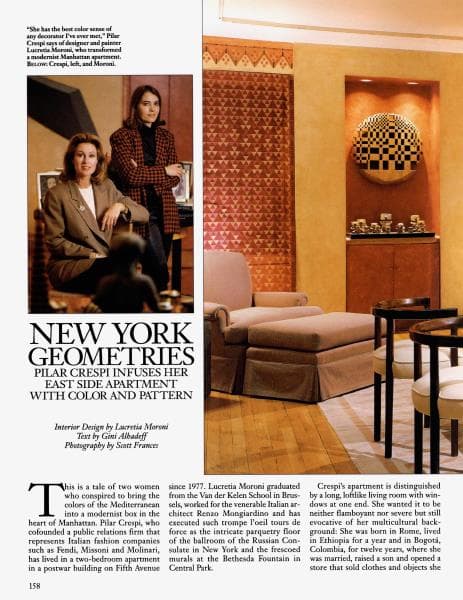
“new york geometries”
by Gini Alhadeff
Home Score Summary (Custom Aesthetic Scoring Instrument v2.3)
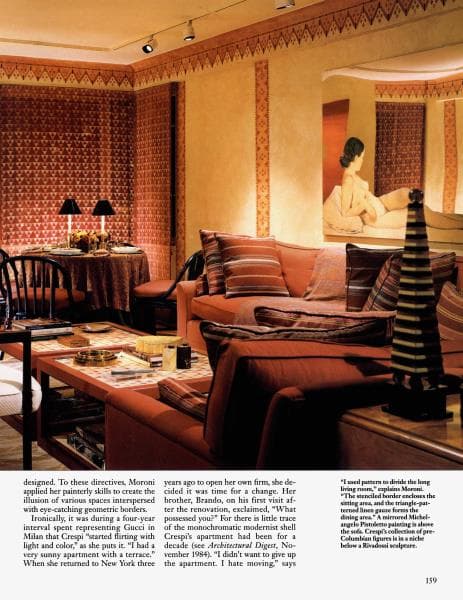
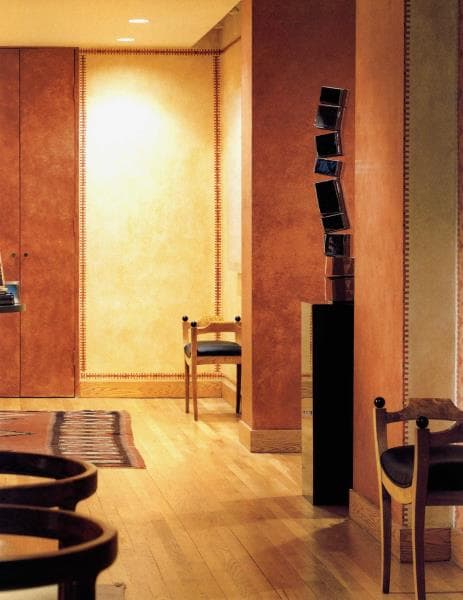
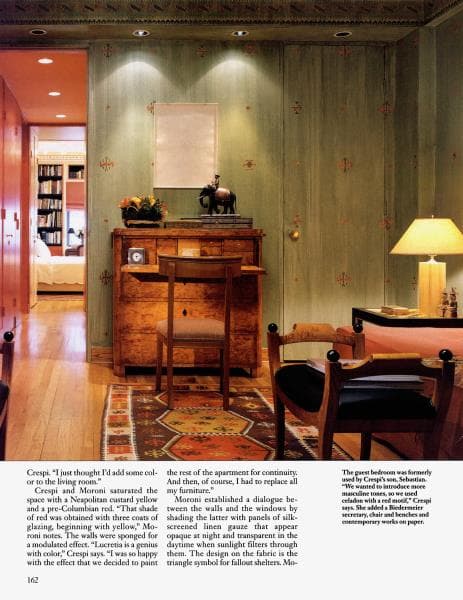
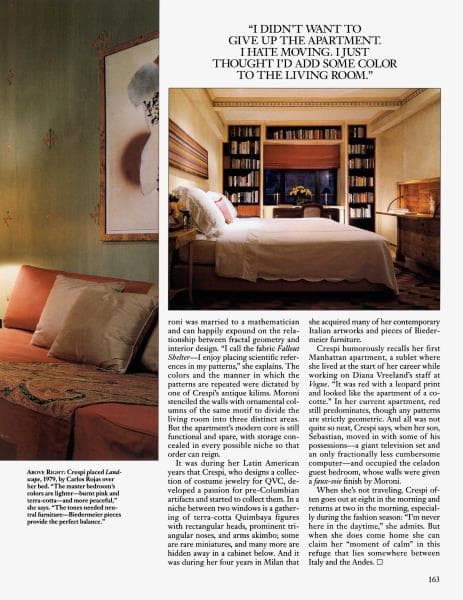
A postwar box alchemized into a warm chromatic cocoon through painted geometric borders and sponged glazes that evoke both Italian frescoes and Andean textiles. The pre-Columbian artifacts and Biedermeier furniture are genuinely accumulated across a peripatetic life, not curated for effect. It's a small apartment that punches above its architectural weight through sheer color conviction and pattern coherence.
Feature Pages
 p.158
p.158 p.159
p.159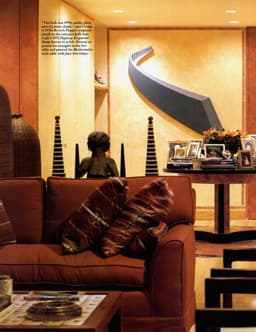 p.160
p.160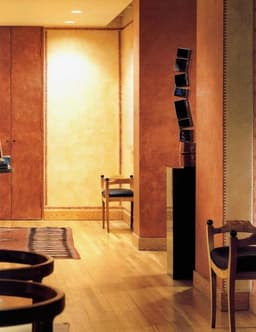 p.161
p.161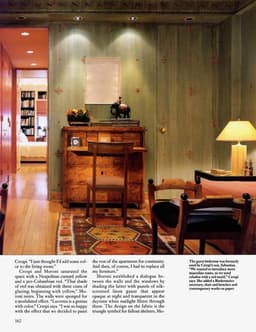 p.162
p.162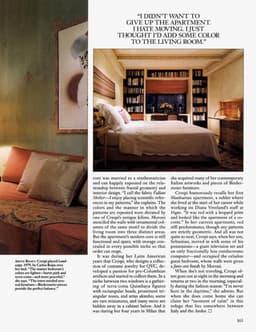 p.163
p.163Home Score
Radial Graph
The score pattern reveals suppressed Grandeur and Theatricality offset by elevated Material Warmth and Curation, with Story constrained by weak Historicism and Hospitality despite strong Provenance—reflecting a home where tactile, chromatic intensity and deliberate pattern control dominate over spatial drama, historical narrative, or performative grandeur.
Scoring Explanations
A two-bedroom postwar apartment on Fifth Avenue with standard ceiling heights; the rooms are compact and human-scale, with no impressive architectural volume despite quality finishes.
The entire apartment is saturated in Neapolitan custard yellow and pre-Columbian red sponged glazes, with warm-toned wood floors, leather upholstery, terracotta-hued walls, and layered textiles — every surface radiates warmth.
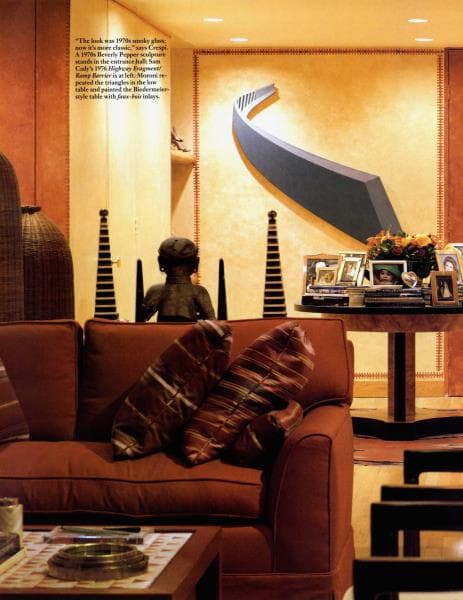
Dense layering of geometric stenciled borders, striped pillows, pre-Columbian figures, Biedermeier furniture, contemporary art, and patterned fabrics all in a coherent warm-toned dialogue — the 'Fallout Shelter' fabric pattern and triangular motifs repeat throughout with deliberate consistency.
Biedermeier pieces mix with pre-Columbian artifacts, contemporary sculpture by Sam Cash and Beverly Pepper, and a modernist shell — it's cross-era mixing driven by personal taste rather than period commitment.
Crespi's Latin American years collecting terra-cotta Quimbaya figures, her multicultural background spanning Rome, Ethiopia, and Bogotá, and the article noting she 'developed a passion for pre-Columbian artifacts and started to collect them' all convey genuine accumulated life rather than decorator staging.
The article describes Crespi as rarely home during the day, returning late from fashion events, with a son's bedroom converted to a guest room; the apartment reads as a personal refuge — 'this refuge that lies somewhere between Italy and the Andes' — not an entertaining venue.
The rooms are considered and composed with carefully arranged vignettes and painted geometric borders, but the deep sofa cushions, layered pillows, and intimate scale invite sitting down rather than standing at attention.
Lucretia Moroni's professional hand is evident in the systematic repetition of triangle motifs across stenciled walls, painted table inlays, and fabric patterns — the geometric program is designer-directed with composed sight lines, though Crespi's personal collection provides authentic content.
The apartment performs for its owner's multicultural identity rather than for outside validation; the pre-Columbian collection and Biedermeier pieces are genuine passions, and the named artworks (Sam Cash, Beverly Pepper, Michelangelo Pistoletto) are knowing choices rather than trophy acquisitions.