Homeowner Name
Mandell and Mary Ourisman
About (information sourced from public biographical records)
Mandell and Mary Ourisman own Ourisman Automotive Group with 36+ dealerships across Virginia and Maryland. Their Washington home was featured in Architectural Digest's March 1997 issue. Mandell inherited Ourisman Chevrolet from his Ukrainian immigrant father and expanded it; Mary, daughter of a Texas dentist, married into the fortune in 1993.
Epstein Connection?
 DETECTIVE
 RESEARCHER
 EDITOR
Property Details
Wealth Score
4.0
/ 10
Wealth Source
MIXED
Ourisman Automotive Group — inherited single-brand dealership expanded into 36+ …
Professional Category
BUSINESS
Fame Score
4
46,057 wiki views
Board Memberships
Board Member (30+ years), Washington National Symphony; Trustee, Corcoran Gallery of Art; Major Benefactor, Kennedy Center; Trustee (Mary), Kennedy Center; Trustee (Mary), Washington National Opera; Emeritus Trustee (Mary), Smithsonian Institution; Unknown (legacy text), Mandell: Corcoran Gallery of Art board. Mary: Smithsonian National Board (Emeritus Trustee), Kennedy Center Board of Trustees, Washington National Opera Board of Trustees.; Board of Directors, Riggs National Corporation; Board Member, Landon School; Member, Young Presidents' Organization (YPO); Board Member, Meridian International Center; Board Member, Acacia Mutual Life Insurance Company; Board Member, Charles E. Smith Residential Realty Inc.; Member, Economic Club of Washington; Participant, Prince of Wales Foundation; Board of Directors (Mary), Blair House Restoration Fund; Member (Mary), World Wildlife Fund National Council; Board Member (Mary), Trust for the National Mall; Member (Mary), Council of American Ambassadors; Unknown (legacy text), Mandell: Riggs National Corporation board, Landon School board, Young Presidents' Organization, Meridian International Center, Acacia Mutual Life Insurance Company board, Charles E. Smith Residential Realty Inc. board, Economic Club of Washington, Prince of Wales Foundation. Mary: Blair House restoration fund board, World Wildlife Fund National Council, Trust for the National Mall, Council of American Ambassadors, Path North.
Influence Score
—
Architectural Digest Issue:
“french style for the capital”
by Susan Mary Alsop
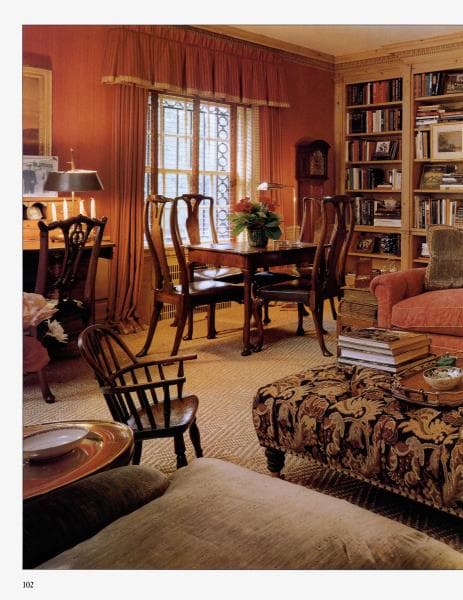
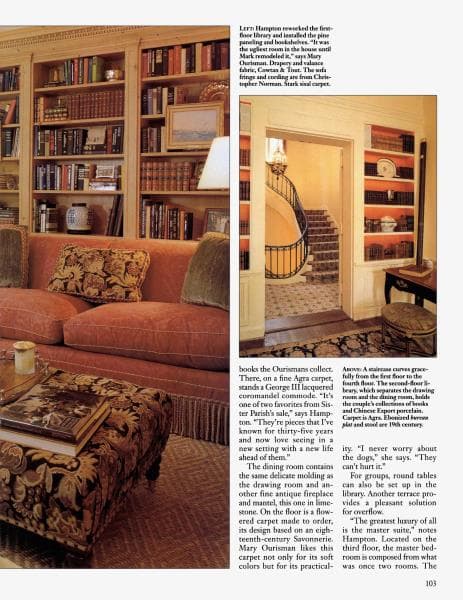
Home Score Summary (Custom Aesthetic Scoring Instrument v2.3)
A Washington power couple's European fantasy executed with professional precision — Louis XVI architecture dressed in Anglo-French antiques, designed less as a home than as a diplomatic stage. The warmth of pine paneling and auction-found chairs keeps it from feeling like a museum, but the thirty-five-foot drawing room and three-hundred-person galas reveal its true purpose. Mark Hampton's hand is everywhere, translating social ambition into historically literate rooms that perform beautifully for guests while the dogs roam the Agra carpets.
Feature Pages
 p.98
p.98 p.99
p.99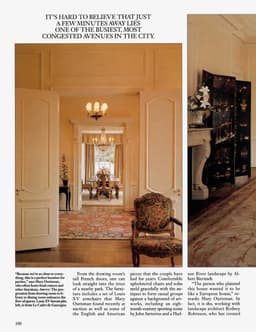 p.100
p.100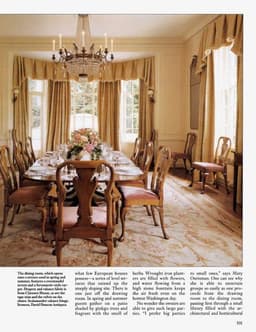 p.101
p.101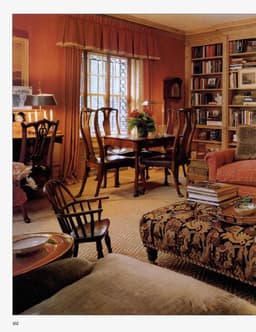 p.102
p.102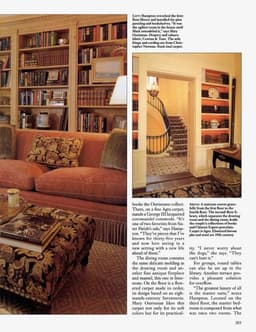 p.103
p.103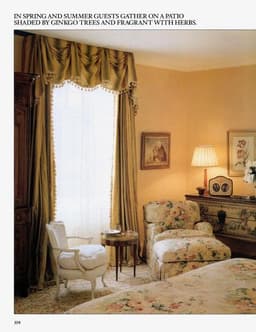 p.104
p.104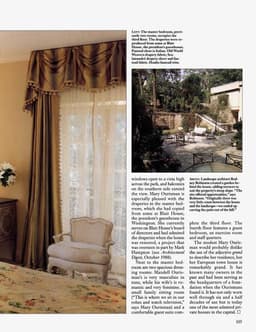 p.105
p.105Home Score
Radial Graph
The home achieves rare equilibrium across Space and Story (both 4.0) while Stage edges slightly lower (3.7), driven by balanced Grandeur and Material Warmth in the first group, elevated Hospitality offsetting weaker Provenance in the second, and suppressed Theatricality tempering otherwise strong Formality and Curation in the third.
Scoring Explanations
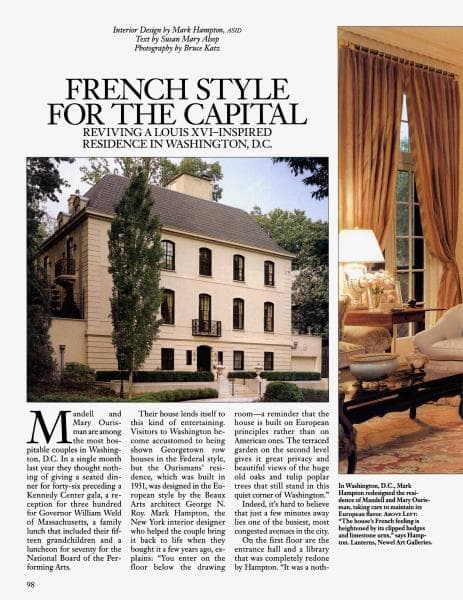
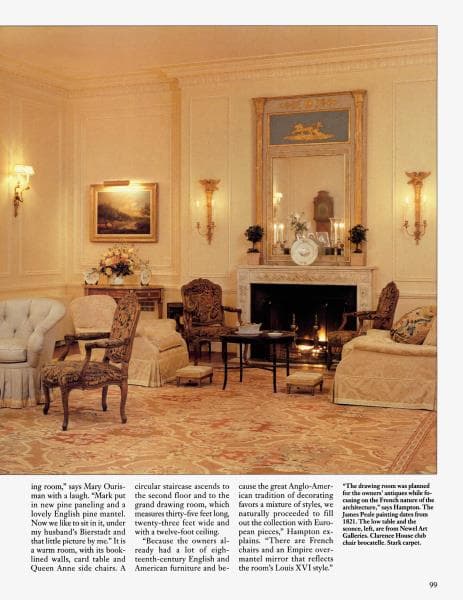
The drawing room measures thirty-five feet long with a twelve-foot ceiling, the house was designed in the European style by Beaux Arts architect George N. Ray, and the limestone and stucco exterior conveys substantial architectural weight.
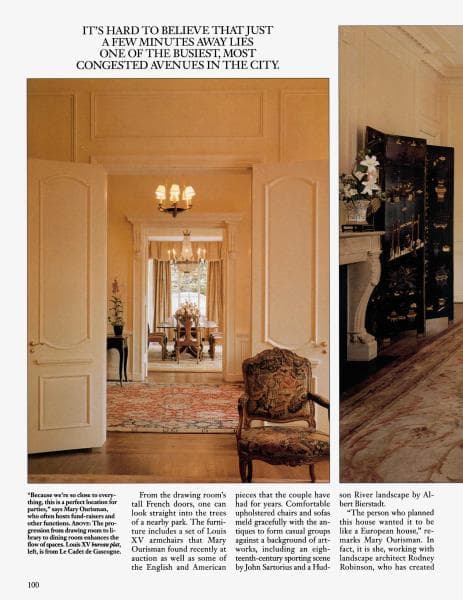
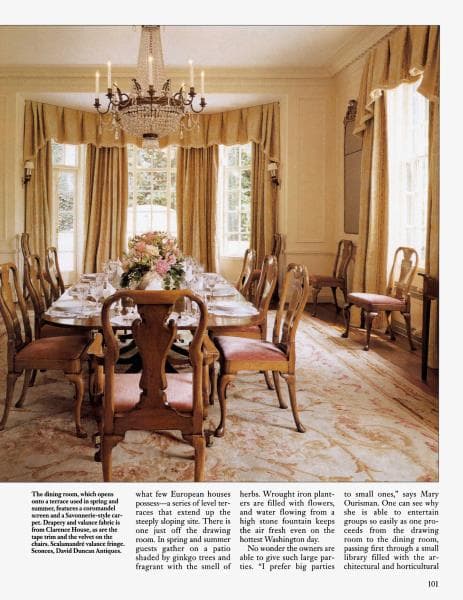
Pine paneling in the library, book-lined walls, upholstered furniture throughout, warm gold tones in the drawing room, Savonnerie-style carpets, and rich drapery fabrics create a predominantly warm tactile environment with only the limestone mantel and mirror as cooler counterpoints.
Dense layering of eighteenth-century English and American furniture, French chairs, Empire overmantel mirror, antique sconces, paintings, Chinese Export porcelain, and pattern-on-pattern in the bedroom — all held together by a coherent Louis XVI-inflected palette.
Strong commitment to Louis XVI and eighteenth-century Anglo-French style throughout — Beaux Arts architecture from 1931, period-appropriate furniture, Savonnerie carpet, draperies copied from Blair House — with only minor modern intrusions like the television mentioned in the sitting room.
Hampton notes pieces he's 'known for thirty-five years' from Sister Parish's sale, and the Ourismans found Louis XV armchairs at auction, but the house was purchased and comprehensively redecorated by a professional designer, making the accumulation convincing but largely fabricated within a single generation.
The article opens by describing three major entertaining events in a single month — a Kennedy Center gala for 300, a reception for a governor, a family luncheon for 70 — and the entire floor plan is described in terms of guest circulation from drawing room to dining room to terraces.
The drawing room with its Empire mirror, French chairs, and carefully composed symmetry, the formally set dining table with crystal chandelier, and the Savonnerie carpet all enforce careful behavior — though Mary Ourisman's comment about Agra carpets being practical because 'the dogs can't hurt it' softens it slightly.
Mark Hampton directed the entire redesign with styled vignettes — the symmetrical drawing room composition, the deliberate pairing of French chairs with Empire mirror, the library transformation — though the owners' personal collecting (auction finds, inherited Bierstadt) keeps some personality visible.
The house clearly communicates wealth and social standing through its European style and scale of entertaining, but the Ourismans' choices lean toward taste rather than brand-broadcasting — no recognizable trophy art, the draperies reference Blair House rather than fashion, and the article emphasizes comfort and practicality alongside grandeur.