Homeowner Name
Jon Robin Baitz and Joe Mantello
About (information sourced from public biographical records)
Jon Robin Baitz is a playwright and TV producer; Joe Mantello is a Broadway director and actor. Their Chelsea apartment was featured in Architectural Digest's November 1995 issue. Baitz grew up upper-middle-class as a Carnation Company VP's son; Mantello grew up middle-class in Illinois as an accountant's son; both built careers in New York theater.
Epstein Connection?
 DETECTIVE
 RESEARCHER
 EDITOR
Property Details
Wealth Score
7.0
/ 10
Wealth Source
SELF MADE
Baitz: playwright, screenwriter, TV producer (Brothers & Sisters, Feud). Mantell…
Professional Category
ENTERTAINMENT
Fame Score
8
492,404 wiki views
Board Memberships
Unknown (legacy text), Baitz: Faculty at The New School (Artistic Director of BFA theater program) and Stony Brook Southampton. Mantello: Founding member of Naked Angels theater company; associate artist at Roundabout Theatre Company.
Influence Score
—
Architectural Digest Issue:
“jon robin baitz and joe mantello”
by Gerald Clarke
Connection Summary (Created by Opus 4.5 based on all evidence collected)
Investigation identified Jon Robin Baitz and Joe Mantello appearing only in DOJ records related to theatre performance contexts, specifically preview performances of plays directed by Joel Grey and written by Larry Kramer. No confirmed connection between either Baitz or Mantello and Jeffrey Epstein was established.
DOJ Documents
10
results in Epstein Library
Evidence Sources
1
DOJ Library
Evidence Entries
0
distinct pieces
Confidence
0%
pipeline certainty
Connection Evidence
The following documents were used as direct evidence of a possible connection for the Researcher and Editor to make an assessment:
Agentic AI Reasoning Logic

Researcher’s Assessment: COINCIDENCE
DOJ results show Joe Mantello and Jon Robin Baitz appearing only in theatre/performance context documents (preview performances of plays directed by Joel Grey, written by Larry Kramer). These are mentions in invitation lists or program materials, not evidence of association with Epstein. No Black Book match.
Reviewed 2/20/2026

Editor’s Final Judgement: REJECTED
Auto-rejected: triaged as COINCIDENCE — DOJ results show Joe Mantello and Jon Robin Baitz appearing only in theatre/performance context documents (preview performances of plays directed by Joel Grey, written by Larry Kramer). These are mentions in invitation lists or program materials, not evidence of association with Epstein. No Black Book match.
Reviewed 2/20/2026
Home Score Summary (Custom Aesthetic Scoring Instrument v2.3)
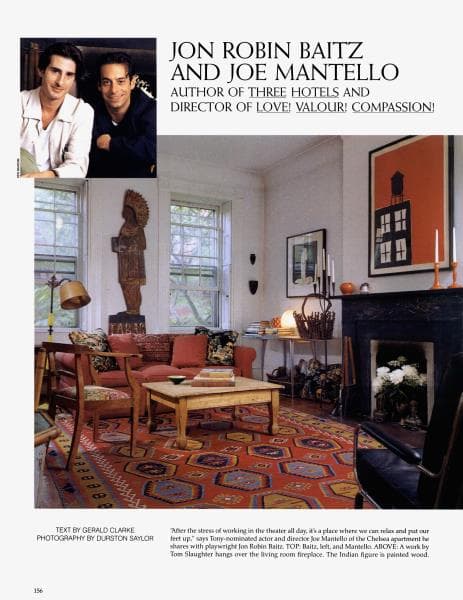
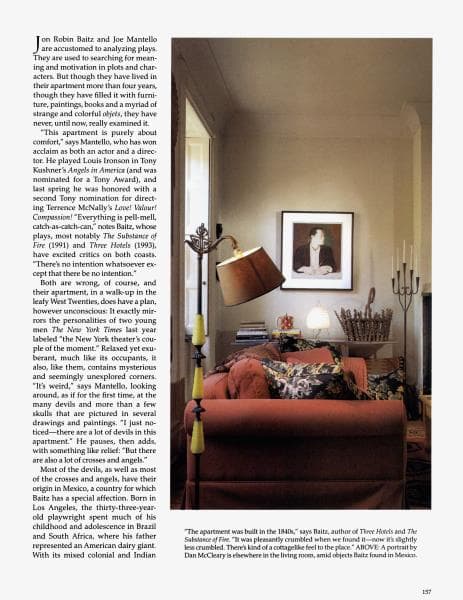
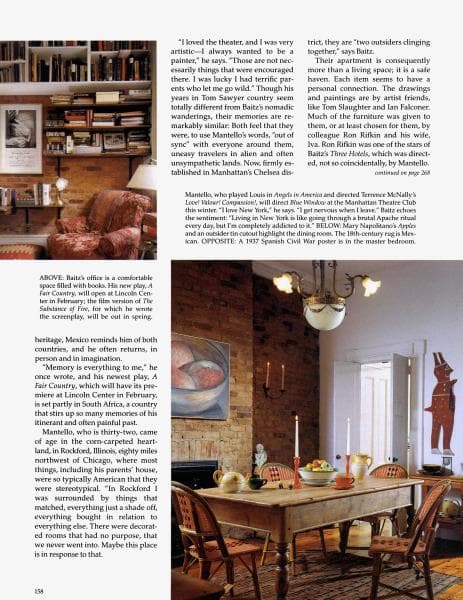
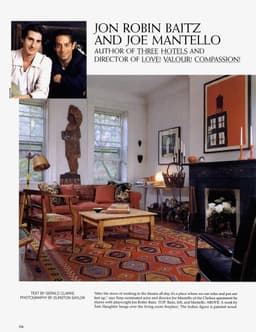
A playwright's and director's genuine nest — pell-mell, catch-as-catch-can, and all the richer for it. Mexican folk art, Brazilian memories, and gifts from theater friends pile up in warm earth tones across a modest Chelsea walk-up that feels like the inside of a well-traveled mind. The devils, crosses, and angels Mantello notices with surprise are the unconscious autobiography of two men who analyze stories for a living but never bothered to read their own apartment.
Feature Pages
 p.156
p.156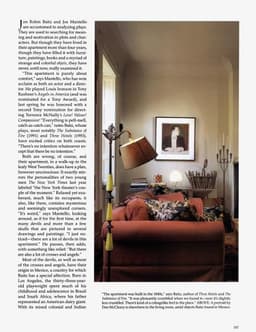 p.157
p.157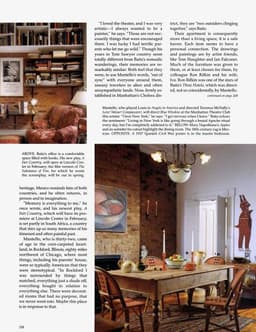 p.158
p.158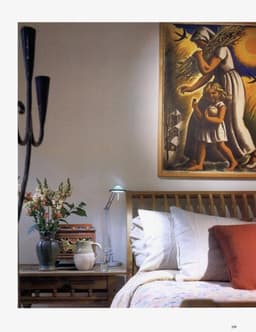 p.159
p.159Home Score
Radial Graph
Space dominates with Material Warmth and Maximalism creating accumulated richness, while Stage is entirely suppressed across all axes and Story diverges sharply through high Provenance offset by near-absent Hospitality and Formality, producing a pattern of intimate personal collection over curated display.
Scoring Explanations
A walk-up Chelsea apartment with standard ceiling heights, human-scale rooms, and drywall construction — the living room, dining room, and bedroom are all intimately proportioned with no architectural pretension.
Every surface radiates warmth: worn Oriental rugs layered on wood floors, linen and velvet upholstery, terracotta tones, wicker baskets, carved wood figures, and a working fireplace — nothing cold or hard anywhere.
Densely layered with folk art, crosses, devils, skulls, drawings, books, textiles, and Mexican objects that maintain coherence through a shared palette of reds, ochres, and earth tones and a consistent folk-art-meets-bohemian sensibility.
The apartment was built in the 1840s and retains some period character in its fireplace mantel and proportions, but the furnishing is a free cross-cultural, cross-era mix of Mexican folk art, Indian figures, and contemporary comfort with no commitment to a single period.
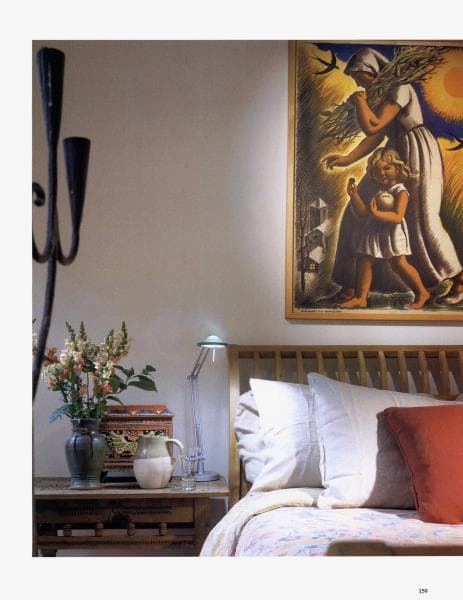
Objects genuinely accumulated from Baitz's childhood in Brazil and South Africa, Mexican travels, and artist friends like Tom Slaughter and Jan Falconer — the article confirms furniture was given by colleagues like Ron Rifkin, and the 1937 Spanish Civil War poster in the bedroom reads as a real find, not a decorator's purchase.
Mantello explicitly describes it as a place to 'relax and put our feet up' after theater work; the apartment is designed entirely for the residents' private retreat, with no entertaining spaces, guest rooms, or public-facing circulation evident.
Curl-up sofas piled with pillows, books stacked everywhere, a 'pell-mell, catch-as-catch-can' philosophy articulated by Baitz himself — this is a space that invites you to take your shoes off and sink in.
Entirely self-curated with no designer credited; the article describes everything as personally accumulated with 'no intention whatsoever except that there be no intention,' and the asymmetric, seemingly random arrangements confirm organic personal collecting rather than styled vignettes.
Nothing here performs for an audience — the art is by personal friends, the furniture was given by colleagues, the folk objects come from genuine biographical connections to Brazil, South Africa, and Mexico, and the overall effect is intimate and private rather than impressive.
Analysis
AD Appearance
CollapseIssue
?/?
Location
Key Findings
Expand