Homeowner Name
Kenneth and Midge Goodhue
About (information sourced from public biographical records)
Kenneth and Midge Goodhue were private residents of Chattanooga featured in AD May 1994 for their Tennessee home.
Epstein Connection?
 DETECTIVE
 RESEARCHER
 EDITOR
Property Details
Wealth Score
8.0
/ 10
Wealth Source
SELF MADE
Chemical industry career and entrepreneurship — sold Alco Chemical Corp in 1989,…
Professional Category
BUSINESS
Fame Score
3
Board Memberships
Board Member, United Way; Board Member, Manker Patten Tennis Center; Unknown (legacy text), Midge Goodhue: United Way board, Manker Patten Tennis Center board. Kenneth: None found.
Influence Score
—
Architectural Digest Issue:
“tennessee two-step”
by Suzanne Stephens
Home Score Summary (Custom Aesthetic Scoring Instrument v2.3)
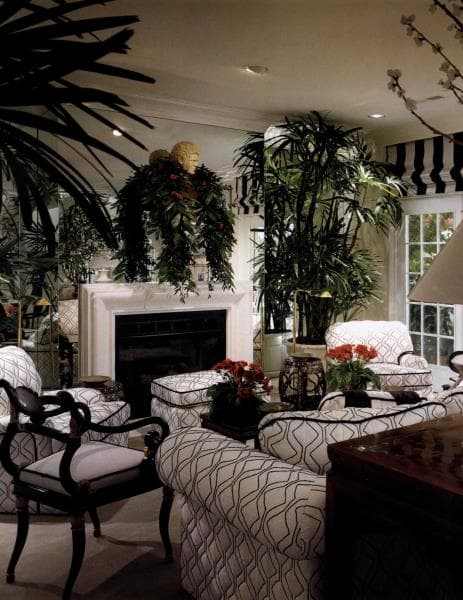
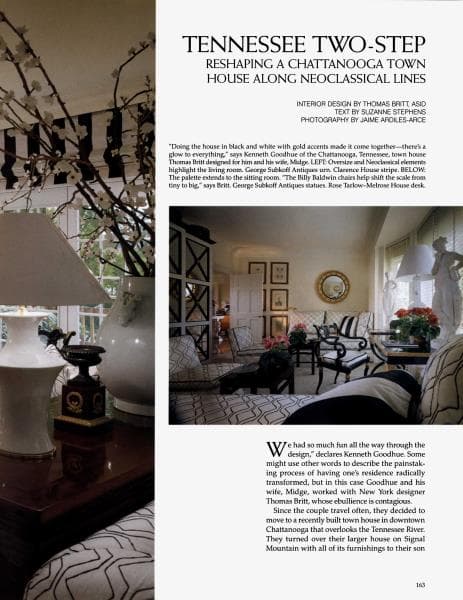
A designer's total picture executed in a disciplined black-white-gold palette: Neoclassical bones dressed with tropical exuberance. Everything arrived at once but the coherence is so complete it reads as confident conviction rather than catalog shopping. Britt's theatrical restraint — dramatic without being loud — makes a Chattanooga town house feel like a sophisticated stage set for cultivated entertaining.
Feature Pages
 p.162
p.162 p.163
p.163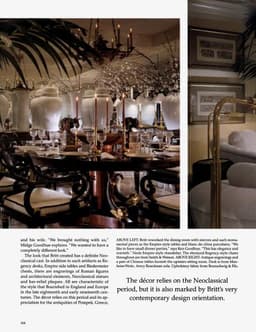 p.164
p.164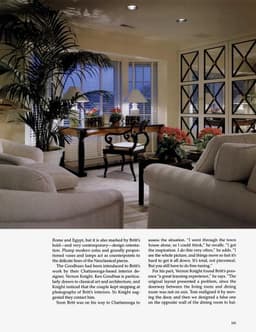 p.165
p.165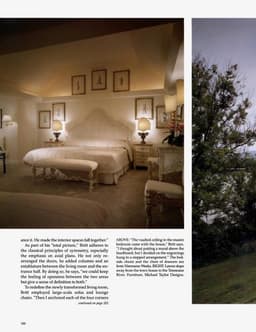 p.166
p.166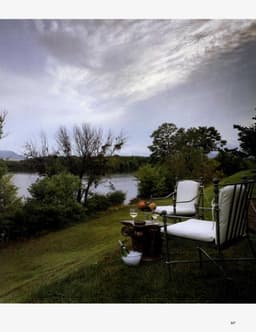 p.167
p.167Home Score
Radial Graph
Stage dominates at 3.7 with Formality and Curation driving visual control, while Story lags at 3.0 despite strong Historicism, suppressed by weak Provenance, and Space remains moderate at 3.3 with Maximalism's exuberance checked by restrained Grandeur and Material Warmth.
Scoring Explanations
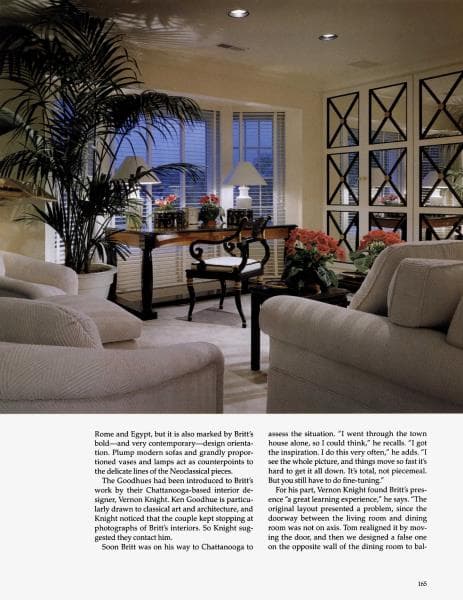
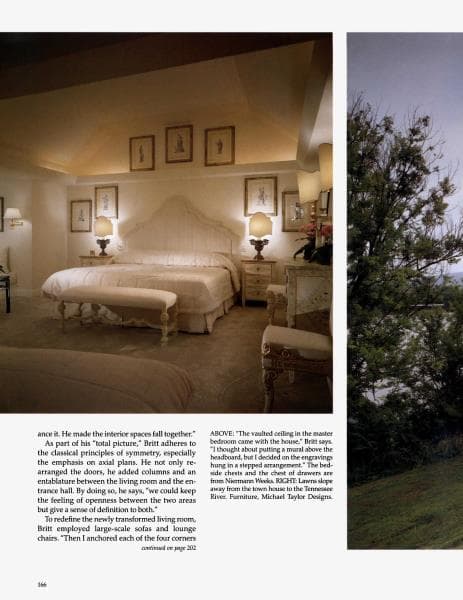
Generous proportions with a vaulted master bedroom ceiling and well-scaled living spaces, but this is a town house with standard residential volumes — the white fireplace surround and comfortable seating areas suggest quality without monumental scale.
A balanced tension between the cool black-and-white color scheme (dark wood frames, white upholstery with graphic pattern, black-and-white striped awning) and warm elements like the fireplace, lush tropical plants, and layered textiles.
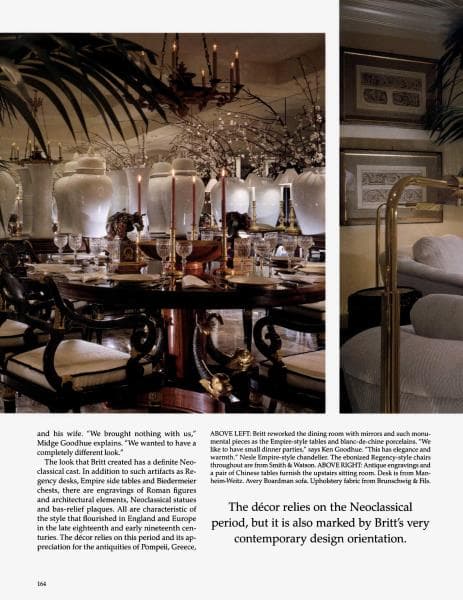
Dense layering of Neoclassical statues, engravings, tropical plants, patterned upholstery, Empire-style tables, and blanc-de-chine porcelains — all cohering within a disciplined black, white, and gold palette that gives every surface activation without chaos.
Strong Neoclassical commitment with Regency-style chairs, Empire side tables, Biedermeier chests, engravings of Roman figures, and bas-relief plaques, though the contemporary scale of sofas and modern recessed lighting are deliberate anachronisms that Britt uses as counterpoints.
The article explicitly states 'We brought nothing with us — we wanted to have a completely different look,' meaning everything was newly purchased for this space; the antiques are acquired period pieces, not inherited or accumulated over time.
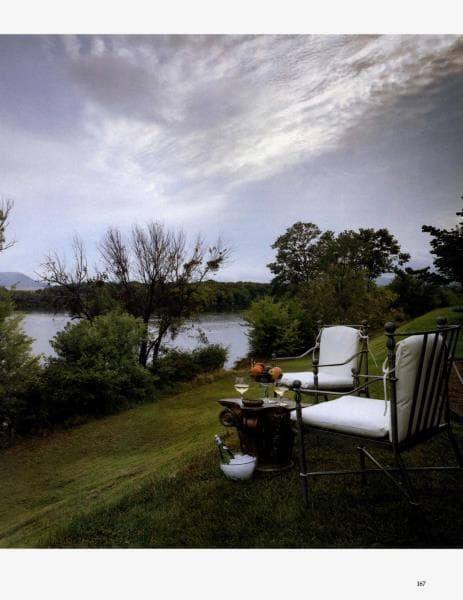
The article mentions the Goodhues 'like to have small dinner parties' and the dining room is set for intimate entertaining, but the overall orientation balances social use with comfortable private living areas and the riverside outdoor setting.
The carefully arranged symmetrical seating groups, pristine white upholstery, Neoclassical statuary, and formal dining table with candelabras and porcelain all impose behavioral rules — these are rooms you respect, not sprawl in.
Thomas Britt's 'total picture' approach with symmetrical axial plans, added columns and entablature, composed sight lines through doorways, and styled vignettes of statues and porcelains clearly show designer-directed composition with the Goodhues' taste as input.
The black-and-white-with-gold scheme is deliberately dramatic and the article quotes the homeowner saying 'there's a glow to everything,' but the performance serves sophisticated taste rather than brand broadcasting — George Subkoff Antiques and Billy Baldwin chairs signal knowledge, not price tags.