Homeowner Name
George Gund III and Miller Ream
About (information sourced from public biographical records)
George Gund III was a Cleveland banking heir and sports team owner who inherited one of Ohio's largest fortunes. His June 1993 AD feature presented his Montana ranch designed by Shari Stevens, co-owned with Miller Ream. Born into 3rd+ generation wealth with a father who led Cleveland Trust Company and left ~$600 million, Gund deployed his inheritance into owning the Cleveland Cavaliers and San Jose Sharks.
Epstein Connection?
 DETECTIVE
 RESEARCHER
 EDITOR
Property Details
Wealth Score
3.0
/ 10
Wealth Source
OLD MONEY
Inherited banking/investment fortune (Cleveland Trust Company, Kellogg's stock);…
Professional Category
SPORTS
Fame Score
5
98,115 wiki views
Board Memberships
Trustee Emeritus, Cleveland Museum of Art; Trustee, National Museum of the American Indian; Trustee, UC Berkeley Art Museum and Pacific Film Archive; Unknown (legacy text), George Gund III: Trustee emeritus of Cleveland Museum of Art; Trustee of National Museum of the American Indian; Board of UC Berkeley Art Museum and Pacific Film Archive. Miller Ream: Supporter of San Mateo County Historical Association.; Trustee, George Gund Foundation; Board Member, Cleveland Orchestra (Musical Arts Association); Chairman, San Francisco Film Society; Trustee, Sundance Institute; Chairman and Trustee, U.S. Hockey Hall of Fame; Trustee, USA Hockey Foundation; Chairman of the Board, Borel Bank & Trust Company; Board Member, Peninsula Community Foundation; Unknown (legacy text), George Gund III: George Gund Foundation (trustee, 44 years); Cleveland Orchestra (Musical Arts Association); Sundance Institute (trustee); San Francisco Film Society (chairman, 40+ years); U.S. Hockey Hall of Fame (chairman/trustee); USA Hockey Foundation (trustee); International Council of USA Hockey. Miller Ream: Chairman of Borel Bank & Trust Company; Peninsula Community Foundation.
Influence Score
—
Architectural Digest Issue:
“a low profile for montana”
by Verlyn Klinkenborg
Home Score Summary (Custom Aesthetic Scoring Instrument v2.3)
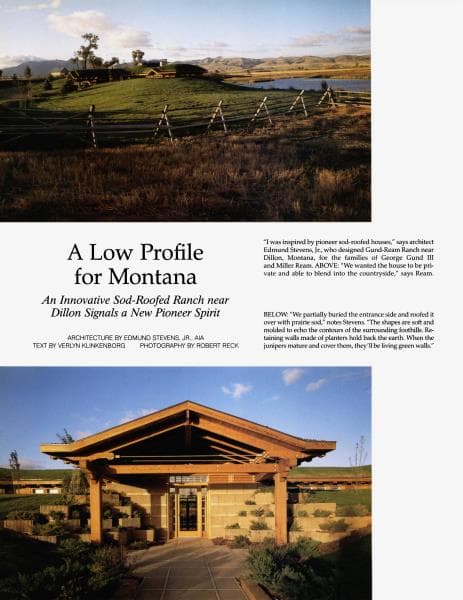
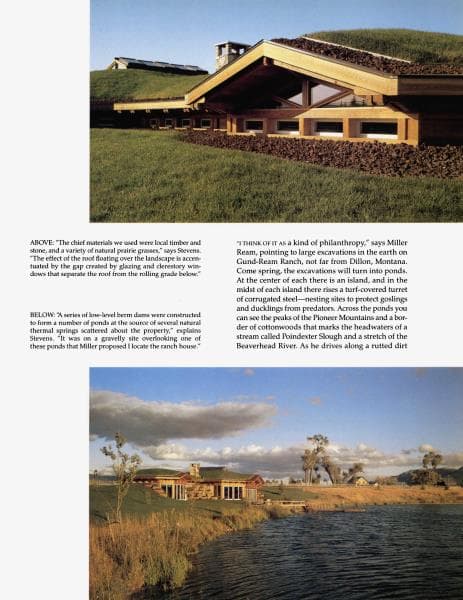
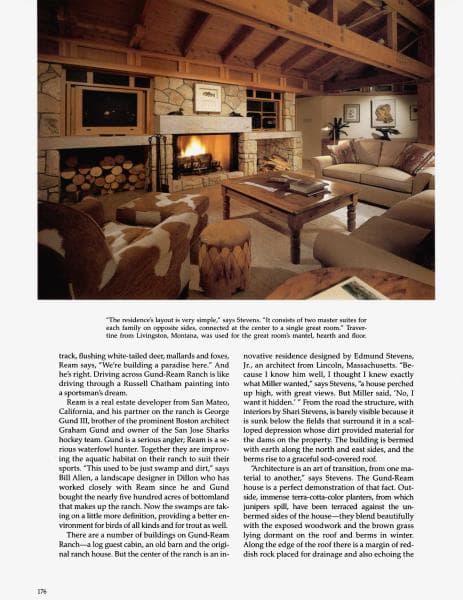
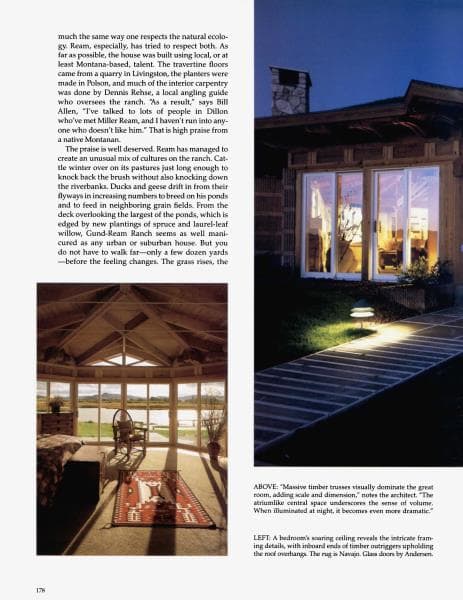
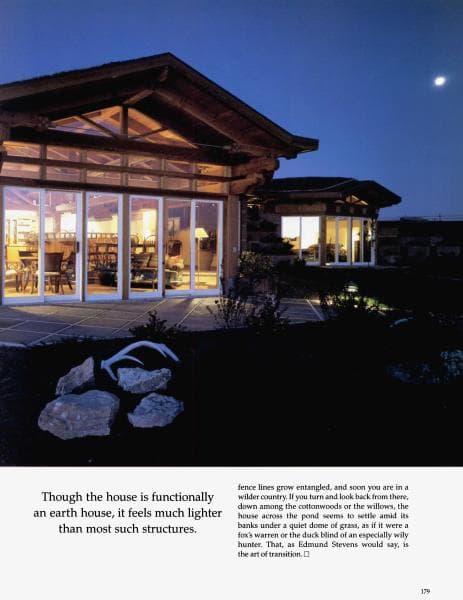
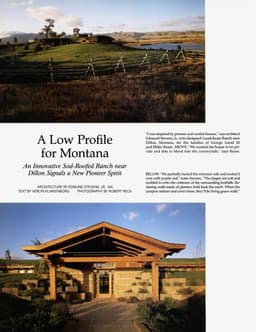
A pioneer fantasy executed with serious engineering and deep pockets — 150 yards of sod on the roof, massive timber trusses, and an earth-sheltered profile that disappears into the Montana foothills. The architecture performs for the landscape, not for visitors; wealth here buys invisibility, not spectacle. It's a sportsman's lodge that happens to be an experimental earth house, where the Russell Chatham painting and Navajo rugs feel earned by the setting rather than curated for effect.
Feature Pages
 p.174
p.174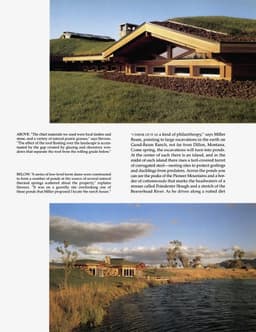 p.175
p.175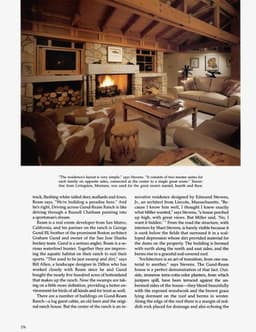 p.176
p.176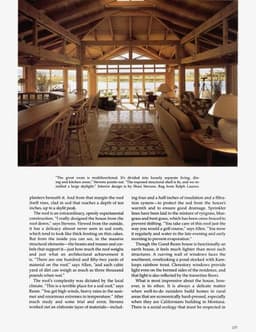 p.177
p.177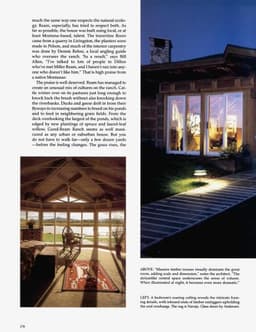 p.178
p.178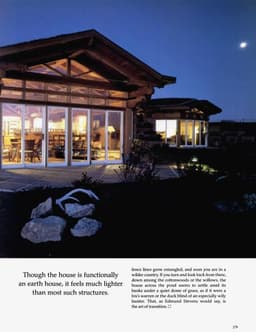 p.179
p.179Home Score
Radial Graph
The Space group dominates at 3.7 through Material Warmth and Grandeur, while Story and Stage converge at 2.3, both suppressed by low Formality and Theatricality, creating a pattern where sensory and structural presence far exceeds historical narrative or performative staging.
Scoring Explanations
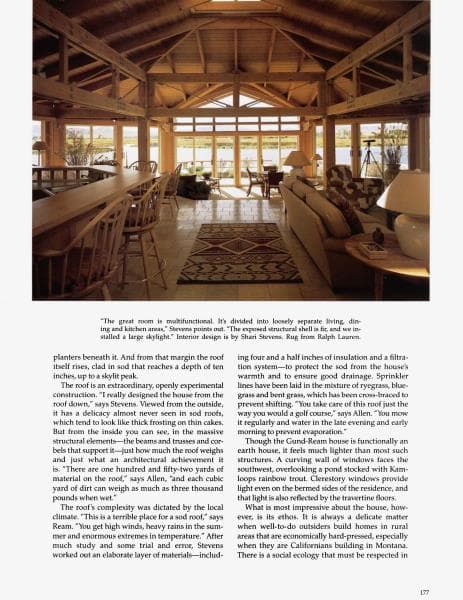
Massive timber trusses dominate the great room with soaring ceilings, exposed structural beams, and corbels creating impressive volume; the architecture has genuine weight and scale despite its earth-sheltered profile.
Local timber throughout, travertine floors from Livingston, exposed wood beams and trusses, stone fireplace, prairie sod roof, terra-cotta planters, and Navajo rugs create an entirely tactile, natural material palette with no cold surfaces.
Interiors are restrained with breathing room — a Russell Chatham painting, some Navajo rugs, the fireplace mantel, and sparse furnishings; the architecture itself is the primary object, not layered collections.
The sod-roof concept references pioneer homesteads and Stevens explicitly cites 'pioneer sod-roofed houses' as inspiration, but the execution is thoroughly contemporary with clerestory windows, modern glazing, and open-plan living.
This is new construction with new furnishings; while the materials are honest and local (quarried travertine, local timber, carpentry by a local angling guide), nothing here has accumulated over time — it arrived together.
The layout consists of two master suites for two families connected by a single great room that functions as living, dining, and kitchen, suggesting a balance between private retreat and shared social space for the two partner families.
Despite the impressive timber structure, the sod roof, worn-looking natural materials, ranch setting, and the article's emphasis on blending into the landscape and building paradise for hunting and fishing all signal a deeply casual, lived-in ethos.
Interior design credited to Shari Stevens with carefully placed furnishings, a Ralph Lauren rug, and composed sight lines through the great room, but the overall feeling remains organic and site-driven rather than editorially styled.
The house is deliberately hidden — 'We wanted the house to be private and able to blend into the countryside' — buried in berms with a sod roof, representing wealth that explicitly does not want to be seen, an anti-theatrical statement.