Homeowner Name
Siddarth and Yashodhara Bhansali
About (information sourced from public biographical records)
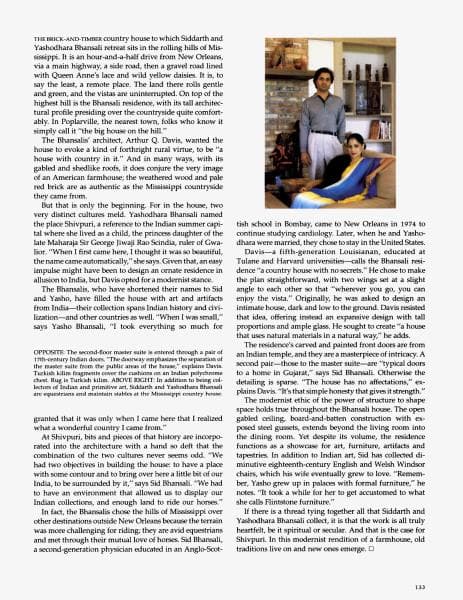
The Bhansalis resided in Poplarville, Mississippi, when featured in Architectural Digest in June 1991.
Epstein Connection?
 DETECTIVE
 RESEARCHER
 EDITOR
Property Details
Wealth Score
3.0
/ 10
Wealth Source
MIXED
Siddharth's cardiology career (Ochsner Health, New Orleans area) combined with Y…
Professional Category
MEDICINE
Fame Score
2
Board Memberships
Fellow, New Orleans Museum of Art; Advisory Board Member, Contemporary Art Center (New Orleans); Unknown (legacy text), Yashodhara: Fellow of the New Orleans Museum of Art; Advisory Board Member of the Contemporary Art Center (New Orleans); Board Member, Delta Festival Ballet; Unknown (legacy text), Yashodhara: Board member of the Delta Festival Ballet; fundraiser for the Audubon Zoological Society (raised $250,000 for permanent Indian exhibit at Audubon Zoo)
Influence Score
—
Architectural Digest Issue:
“mississippi modern”
by Beth Dunlop
Home Score Summary (Custom Aesthetic Scoring Instrument v2.3)
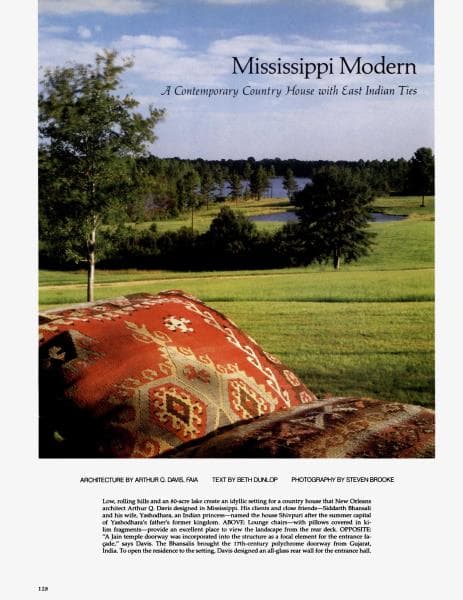
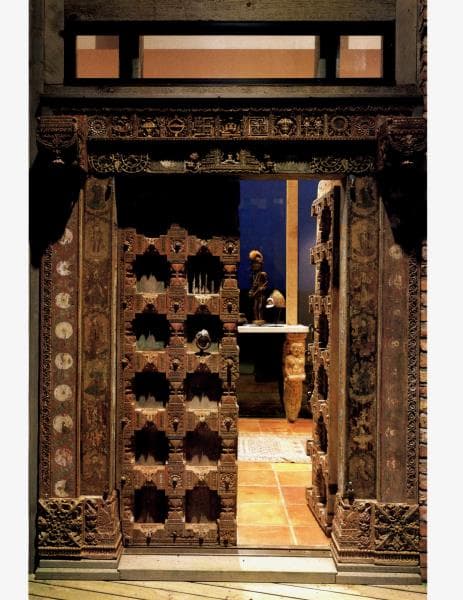
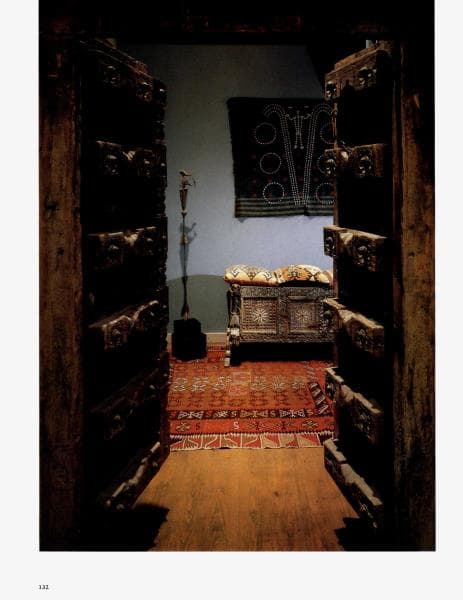
A brick-and-timber country house where centuries-old Jain temple doors open onto Mississippi rolling hills — the collision of Gujarati heritage and American farmhouse vernacular feels earned, not curated. The warmth is overwhelming: rough-sawn wood, kilim rugs, terracotta floors, and carved brackets create a deeply tactile retreat where the collection serves memory rather than display. Davis's 'rustic contemporary' frame is the quiet architecture that lets the Bhansalis' cultural inheritance speak.
Feature Pages
 p.128
p.128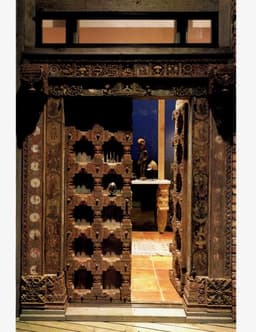 p.129
p.129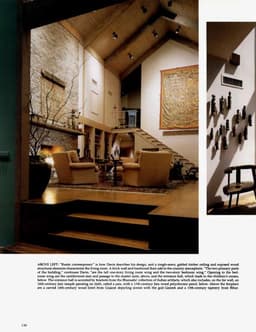 p.130
p.130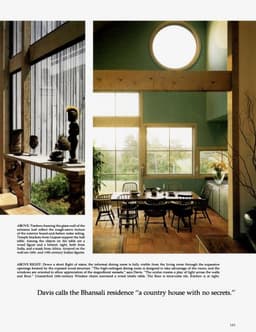 p.131
p.131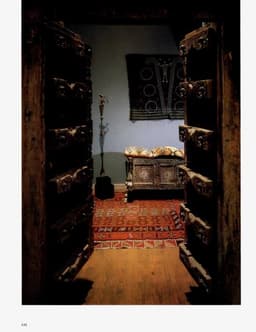 p.132
p.132 p.133
p.133Home Score
Radial Graph
The score pattern shows Space dominates (4.3) driven by Material Warmth and Maximalism, while Story fragments (3.0) with strong Provenance undermined by weak Hospitality, and Stage recedes (2.3) across all axes, revealing a home that prioritizes sensory accumulation and historical anchoring over performative curation or formal reception.
Scoring Explanations
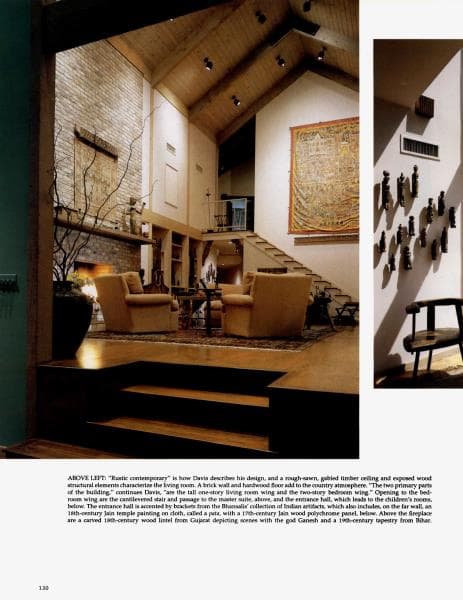
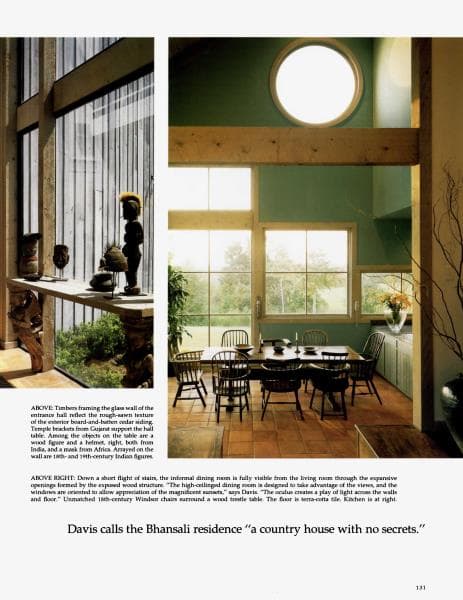
The living room features a dramatic double-height gabled timber ceiling with exposed wood structure, and the dining room has high ceilings with an oculus and expansive glass walls — impressive volume that commands attention without being palatial.
Rough-sawn timber ceilings, brick walls, hardwood floors, terracotta tile, kilim rugs, carved wood Indian doors, and linen upholstery create an overwhelmingly tactile, natural warmth throughout every room.
Indian artifacts, carved temple doors, kilim pillows, African masks, Jain temple paintings, polychrome panels, and tapestries from Bihar are densely layered yet unified by a consistent East Indian-meets-rustic-American dialogue.
The house mixes 17th-century Jain polychrome doorways, 18th-century carved wood lintels, and 19th-century Indian tapestries within a contemporary timber-frame structure — rich historical objects but no commitment to a single period.
The Bhansalis' collection of Indian artifacts reflects genuine cultural inheritance — family connections to Gujarat and Bihar — and the carved doors and temple brackets show real age, wear, and patina accumulated over centuries.
Davis calls it 'a country house with no secrets,' but the article emphasizes personal retreat — an hour-and-a-half drive from New Orleans, rolling hills for horseback riding, and spaces designed around the couple's collection and equestrian life rather than entertaining.
The lounge chairs on the deck with kilim pillows, the Windsor chairs around a wood trestle table, and the overall 'rustic contemporary' ethos described by Davis create a relaxed, lived-in atmosphere despite the impressive objects.
Architect Arthur Q. Davis shaped the spatial framework and integrated the Indian architectural elements, but the Bhansalis' personal collection — amassed from family history and their own travels — gives the interiors genuine owner personality alongside professional design.
The wealth here is cultural rather than conspicuous — ancient temple doors and tribal textiles don't broadcast price tags, and the rural Mississippi hilltop location signals private retreat rather than social performance.