Homeowner Name
Prince Victor Emmanuel of Savoy and Princess Marina
About (information sourced from public biographical records)
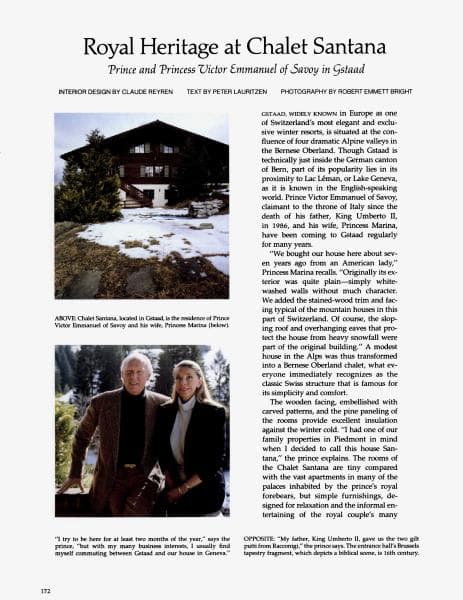
Prince Victor Emmanuel headed the House of Savoy after Italy abolished the monarchy; Princess Marina inherited the Doria confectionery fortune. Their Gstaad chalet appeared in Architectural Digest in February 1991. Vittorio Emanuele was born to Italy's last king; Marina's father founded the Doria biscuit company in Switzerland.
Epstein Connection?
 DETECTIVE
 RESEARCHER
 EDITOR
Property Details
Wealth Score
2.0
/ 10
Wealth Source
OLD MONEY
House of Savoy royal dynasty (inherited titles, assets, and connections); supple…
Professional Category
ROYALTY
Fame Score
6
788,892 wiki views
Board Memberships
Unknown (legacy text), None found (cultural philanthropy channeled through Dynastic Orders of the House of Savoy; patrons of Save Venice); Sovereign and Grand Master, Dynastic Orders of the Royal House of Savoy (Order of Saints Maurice and Lazarus); Patron, American Foundation of Savoy Orders; Member, Propaganda Due (P2) Masonic Lodge; Unknown (legacy text), Grand Master of the Dynastic Orders of the Royal House of Savoy (Order of Saints Maurice and Lazarus); member of Propaganda Due (P2) Masonic lodge; patron of American Foundation of Savoy Orders
Influence Score
—
Architectural Digest Issue:
“royal heritage at chalet santana”
by Peter Lauritzen
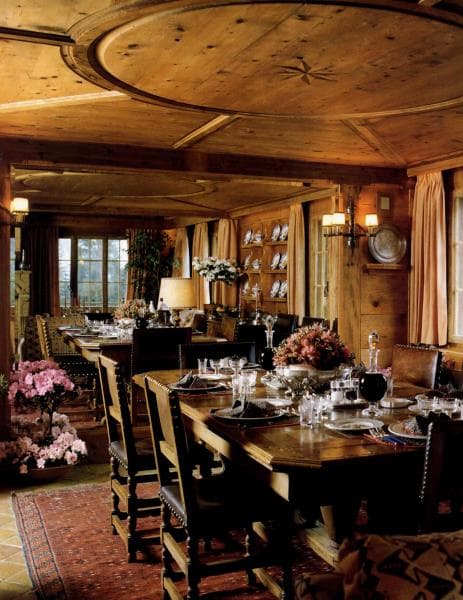
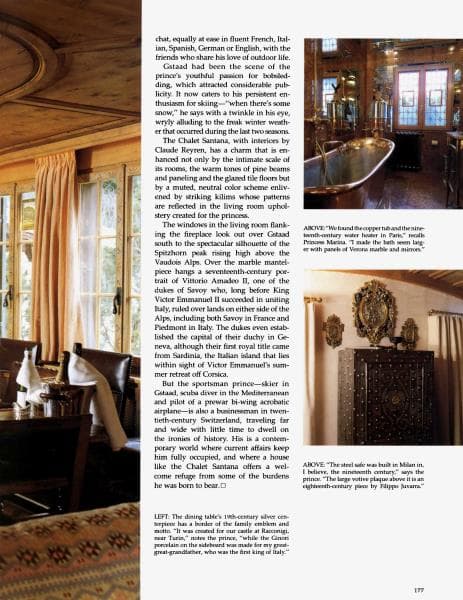
Connection Summary (Created by Opus 4.5 based on all evidence collected)
Investigation revealed that Black Book entries for "Marina" refer to different individuals with the same first name, while DOJ records for "Savoy" reference a Florida court reporter and unrelated financial entities rather than the royal family. No confirmed connection between Prince Victor Emmanuel of Savoy, Princess Marina, and Jeffrey Epstein was established.
DOJ Documents
36
results in Epstein Library
Evidence Sources
2
Black Book + DOJ Library
Evidence Entries
0
distinct pieces
Confidence
0%
pipeline certainty
Connection Evidence
The following documents were used as direct evidence of a possible connection for the Researcher and Editor to make an assessment:
Agentic AI Reasoning Logic

Researcher’s Assessment: COINCIDENCE
The Black Book match is only 'last_name_only' for 'Marina' in a contact entry (Clcogna, Marina), which is a common name and insufficient for identification. The DOJ results reference 'Savoy, RPR' (a court reporter/notary public in Florida) and 'Savoy Fund'/'Savoy Group' (financial/corporate entities), not the royal individuals. The AD feature describes an architectural article about a chalet in Switzerland — a non-person property entity. Past investigation of this identical lead already concluded COINCIDENCE.
Reviewed 2/18/2026

Editor’s Final Judgement: REJECTED
Auto-rejected: triaged as COINCIDENCE — The Black Book match is only 'last_name_only' for 'Marina' in a contact entry (Clcogna, Marina), which is a common name and insufficient for identification. The DOJ results reference 'Savoy, RPR' (a court reporter/notary public in Florida) and 'Savoy Fund'/'Savoy Group' (financial/corporate entities), not the royal individuals. The AD feature describes an architectural article about a chalet in Switzerland — a non-person property entity. Past investigation of this identical lead already concluded COINCIDENCE.
Reviewed 2/18/2026
Home Score Summary (Custom Aesthetic Scoring Instrument v2.3)
Generational warmth in a mountain refuge where Savoy dynasty heirlooms coexist unselfconsciously with kilim ottomans and stacked firewood. The 16th-century tapestry and royal porcelain aren't displayed as trophies — they're the family furniture, set against pine paneling that smells of Alpine winters. A prince's cabin that performs for no one.
Feature Pages
 p.172
p.172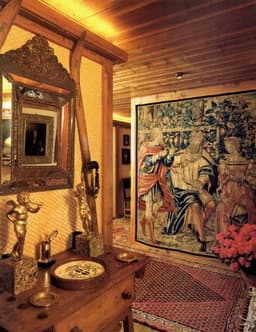 p.173
p.173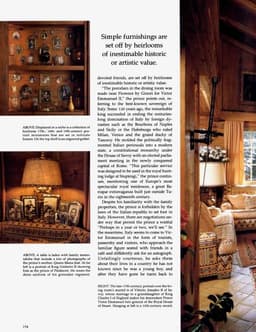 p.174
p.174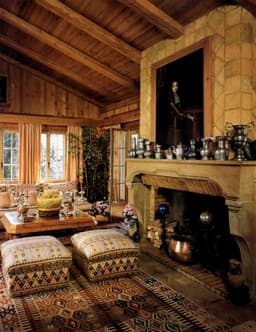 p.175
p.175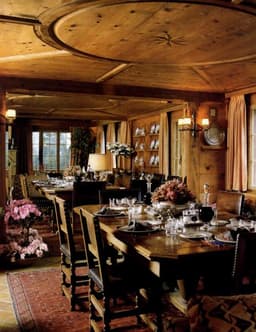 p.176
p.176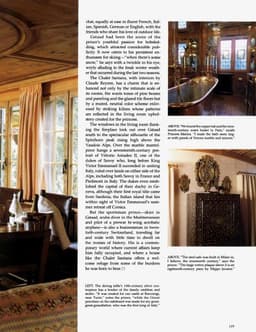 p.177
p.177Home Score
Radial Graph
The aesthetic pattern shows Stage suppressed to half the level of Space and Story, driven by minimal Theatricality (1) and restrained Formality (2), while Material Warmth (5) and Provenance (5) dominate the upper registers to create a lived-in authenticity that actively resists performative curation.
Scoring Explanations
The rooms are intimate and human-scaled as befits a Bernese Oberland chalet, with exposed pine beams and warm wood paneling throughout, yet the marble mantelpiece, 16th-century tapestry, and substantial fireplace give the spaces material weight beyond a simple mountain cabin.
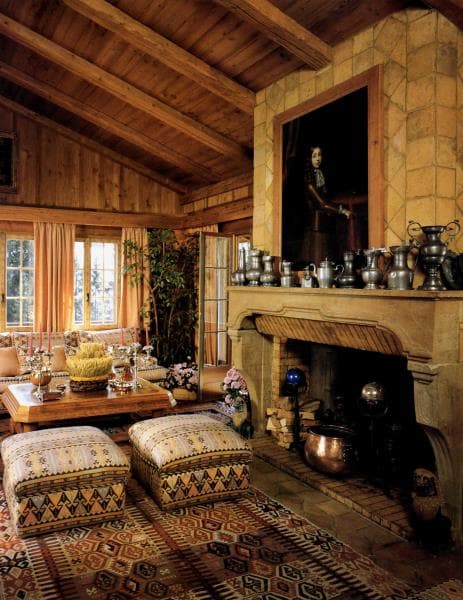
Every surface radiates warmth — stained pine ceilings and beams, carved wood paneling, kilim-upholstered ottomans, oriental rugs on stone floors, copper pots by the fireplace, and linen curtains — there is virtually no cold material anywhere in the chalet.
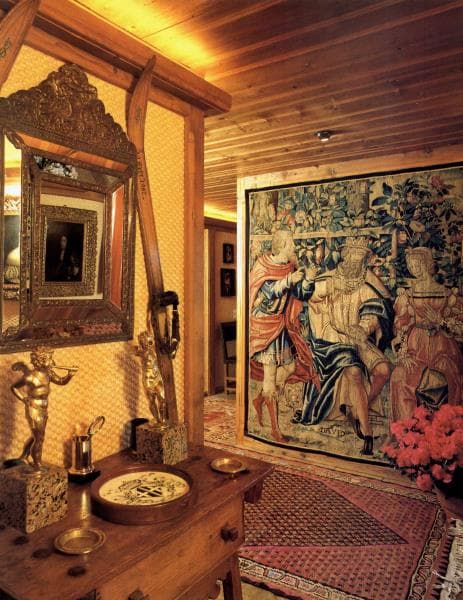
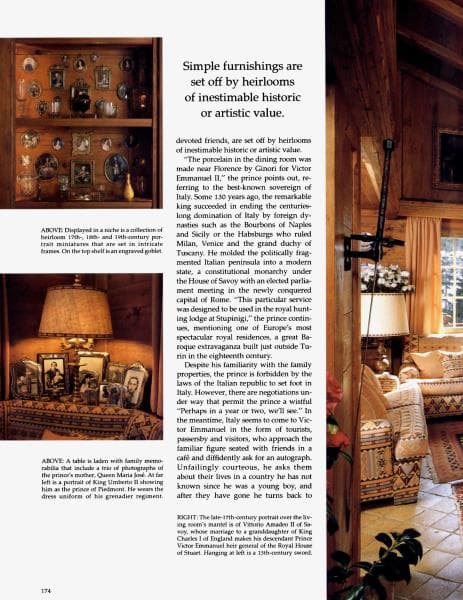
Surfaces are densely activated with coherent layering: portrait miniatures in ornate frames, gilt bronzes, a Brussells tapestry, pewter collections on the mantel, Ginori porcelain in the dining room shelves, kilim textiles, and family photographs all coexist in warm tonal harmony without chaos.
The chalet commits strongly to a traditional Swiss Alpine vocabulary with period-appropriate carved wood paneling and stained timber, enriched by 17th-century Savoy portraits, 16th-century tapestries, and 18th-century Ginori porcelain, with only minor modern intrusions visible.
The article explicitly describes gifts from King Umberto II, a 17th-century portrait of Vittorio Amadeo II, family crests, a 16th-century Brussels tapestry, Ginori porcelain made for the royal hunting lodge at Stupinigi, portrait miniatures spanning three centuries, and photographs of the prince's mother Queen Maria José — these are genuine dynastic heirlooms, not purchases.
The dining room with its long table set for a sizeable dinner party and the article's mention of entertaining 'devoted friends' suggest social use, but the prince describes the chalet as a 'welcome refuge from some of the burdens he was born to bear,' indicating it serves primarily as a private retreat.
Despite the royal heirlooms, the kilim-covered ottomans, firewood stacked casually by the hearth, copper pots on the floor, and the intimate pine-paneled rooms create an environment designed for relaxation — the article explicitly states furnishings are 'simple' and 'designed for relaxation and the informal entertaining of the royal couple's many friends.'
Interior designer Claude Reyren is credited, and there are composed vignettes like the entry console with gilt bronzes flanking the tapestry, but the family memorabilia, inherited objects, and personal photographs clearly reflect the owners' lives rather than editorial staging.
The wealth here is entirely inherited and understated — 17th-century Savoy portraits, centuries-old tapestries, and royal porcelain are displayed without explanation or fanfare in a modest Alpine chalet; nothing is chosen to impress visitors, it simply arrived across generations of one of Europe's oldest dynasties.
Analysis
AD Appearance
CollapseIssue
2/1991
Notes
{"social_circle": "The prince entertains many devoted friends at the chalet; he is approached by tourists and visitors in Gstaad who recognize him as the Italian royal claimant; the article mentions his youthful passion for bobsledding attracted considerable publicity in Gstaad.", "previous_owners": ["An American lady"]}
Designer
Claude Reyren
Location
Gstaad, None
Design Style
Bernese Oberland Alpine chalet with Italian royal heirlooms
Article Title
Royal Heritage at Chalet Santana
Key Findings
Expand