Homeowner Name
Neal Beckstedt
About (information sourced from public biographical records)
Neal Beckstedt is an architect and interior designer who founded Neal Beckstedt Studio in 2010. His Sag Harbor home will appear in Architectural Digest's May 2025 issue. Raised on a farm in rural Ohio to a postal carrier father and county fiscal officer mother, he earned a Bachelor of Architecture from Ball State University and worked at Arquitectonica before establishing his AD100-recognized practice.
Epstein Connection?
 DETECTIVE
 RESEARCHER
 EDITOR
Property Details
Wealth Score
8.0
/ 10
Wealth Source
SELF MADE
Founder and principal of Neal Beckstedt Studio, a boutique architecture and inte…
Professional Category
ARCHITECTURE_DESIGN
Fame Score
3
Board Memberships
—
Influence Score
—
Architectural Digest Issue:
“golden age”
by Mayer Rus
Connection Summary (Created by Opus 4.5 based on all evidence collected)
Investigation identified Neal Beckstedt in DOJ records only as a designer/architect credited in an Architectural Digest magazine article, representing a professional credit rather than evidence of personal contact. No confirmed connection between Beckstedt and Jeffrey Epstein was established.
DOJ Documents
1
results in Epstein Library
Evidence Sources
1
DOJ Library
Evidence Entries
0
distinct pieces
Confidence
0%
pipeline certainty
Connection Evidence
The following documents were used as direct evidence of a possible connection for the Researcher and Editor to make an assessment:
Agentic AI Reasoning Logic

Researcher’s Assessment: COINCIDENCE
Neal Beckstedt appears in DOJ records only as a designer/architect credited in an Architectural Digest show house feature article. This is a professional credit in a published magazine article, not evidence of personal contact with Epstein. No Black Book match exists. The DOJ mention is contextual and related to design work, not suspicious activity.
Reviewed 2/15/2026

Editor’s Final Judgement: REJECTED
Auto-rejected: triaged as COINCIDENCE — Neal Beckstedt appears in DOJ records only as a designer/architect credited in an Architectural Digest show house feature article. This is a professional credit in a published magazine article, not evidence of personal contact with Epstein. No Black Book match exists. The DOJ mention is contextual and related to design work, not suspicious activity.
Reviewed 2/15/2026
Home Score Summary (Custom Aesthetic Scoring Instrument v2.3)
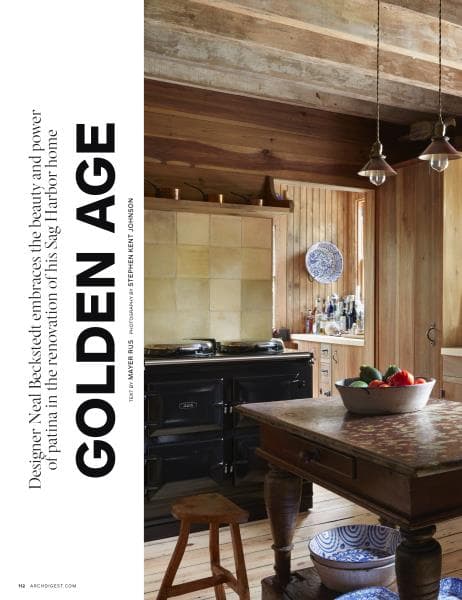
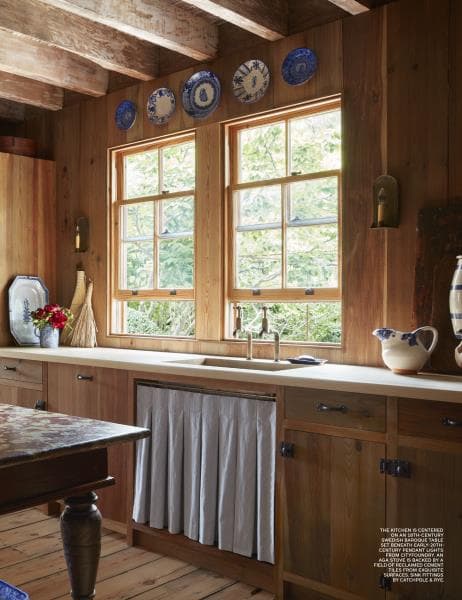
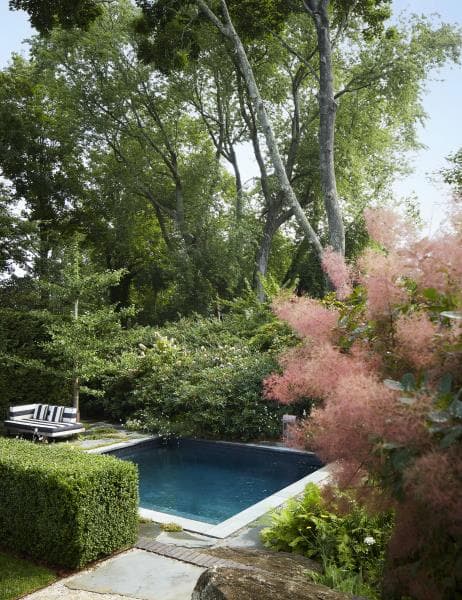
A designer's deeply personal archaeology of a humble 1890s worker's cottage, where every intervention was a subtraction rather than an addition. The warmth is almost overwhelming — copper, cedar, pine, linen, wicker — layered with a polyglot collection of antiques that never announces its pedigree. This is wealth expressed as the discipline of restraint, a barn-raised childhood remembered through French luminaries and Swedish cupboards.
Feature Pages
 p.112
p.112 p.113
p.113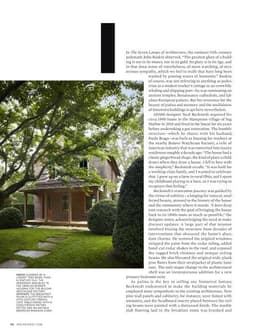 p.114
p.114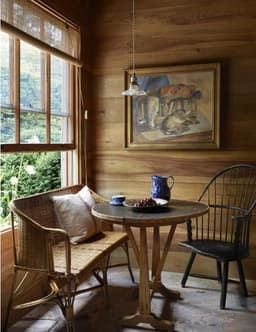 p.115
p.115 p.116
p.116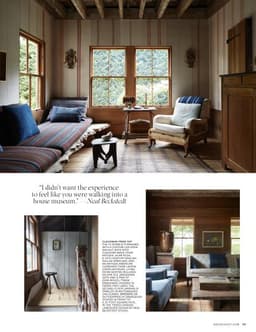 p.117
p.117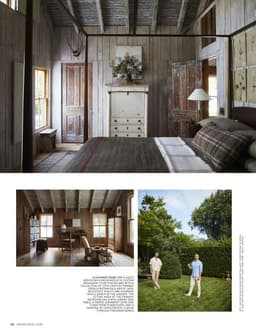 p.118
p.118 p.119
p.119 p.120
p.120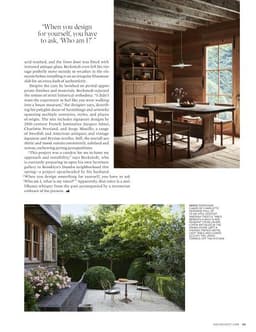 p.121
p.121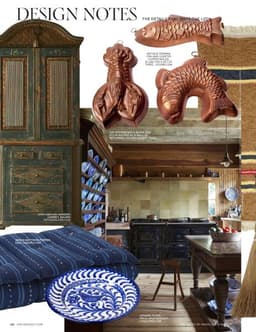 p.122
p.122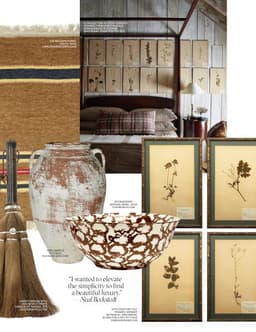 p.123
p.123Home Score
Radial Graph
The scoring pattern shows Space anchored by exceptional Material Warmth (5) that suppresses Grandeur (2), while Story maintains moderate strength through Historicism and Provenance (both 4) despite collapsed Hospitality (2), and Stage is systematically suppressed across all axes—particularly Formality and Theatricality (both 1)—creating a profile driven by tactile authenticity and restraint rather than display or social performance.
Scoring Explanations
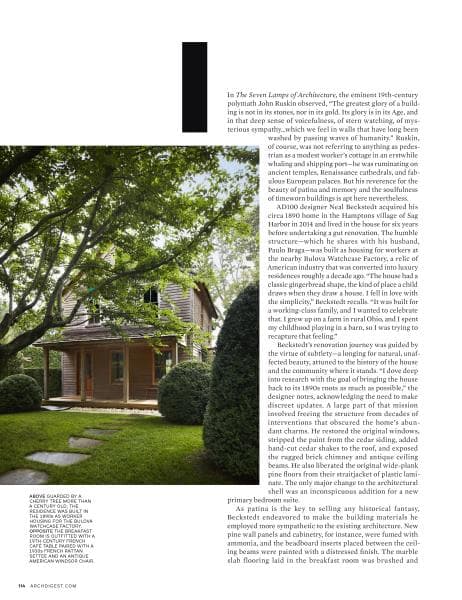
A modest circa-1890 worker's cottage with human-scale rooms, exposed timber ceiling beams, and intimate proportions throughout — the article explicitly notes it was 'built for a working-class family' and Beckstedt fell in love with 'the simplicity.'
Every surface radiates tactile warmth: reclaimed pine wall paneling, wide-plank oak floors, copper bathtub, hand-cut cedar shakes, linen upholstery, wicker furniture, and antique wood throughout — there is virtually no cold material anywhere in the home.
Dense layering of blue-and-white ceramics, copper molds, framed French botanicals, Persian textiles, antique pitchers, and collected objects across every room, all in a tightly coherent warm-toned palette that creates rich dialogue without chaos.
Strong period commitment to a 19th-century American vernacular with an AGA stove, Windsor chairs, reclaimed yellow cement tiles, copper tub with brass fixtures, and beadboard walls — the only modern intrusions are discreetly hidden, and the article describes deep research to bring the house 'back to its 1890s roots as much as possible.'
The building itself is genuinely old (circa 1890 Bulova Watchcase Factory housing), the cedar siding was stripped to reveal original layers, ragged brick chimneys were exposed, and the potbelly stove was left outside to weather — though the interior furnishings are a curated mix of purchased antiques rather than inherited family pieces.
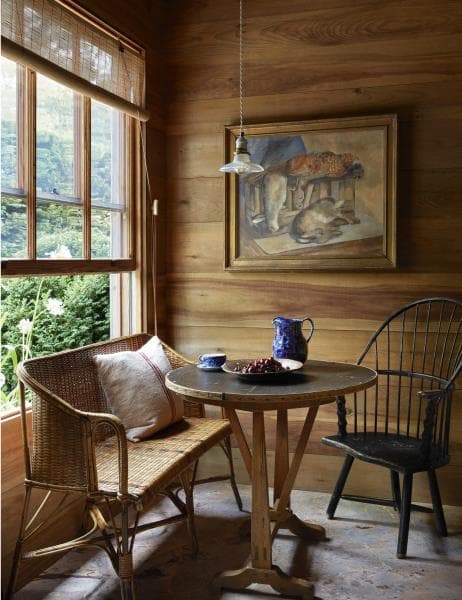
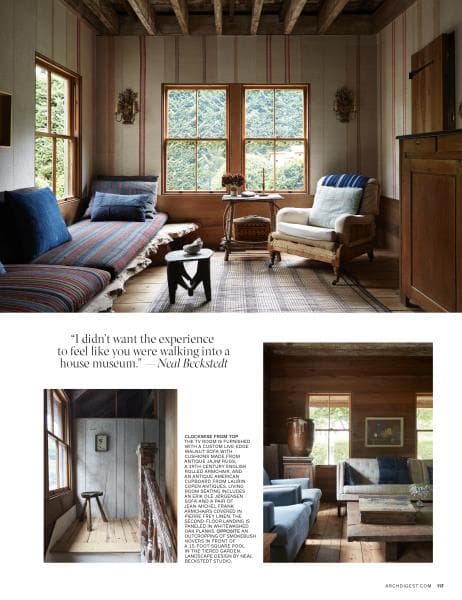
This reads as a deeply personal retreat — a small breakfast nook for two, an intimate TV room, private bedrooms with personal collections — designed for Beckstedt and his husband Paulo Brage rather than for entertaining, with no mention of parties or guest wings.
Worn wood floors, curl-up daybeds with cushions, a kitchen island that doubles as a dining table, wicker settees, and distressed finishes throughout create a space that says 'take your shoes off and stay' — the quote 'I didn't want the experience to feel like you were walking into a house museum' confirms the anti-formal intent.
Beckstedt is a professional designer curating his own home with clear editorial sensibility — the 'polyglot décor' spanning Jacques Adnet, Charlotte Perriand, and Serge Mouille is deliberately composed — but the article makes clear this was a personal project to express 'Who am I?' rather than to create a publishable set piece.
The entire project is an exercise in anti-performance: celebrating a humble worker's cottage, embracing patina over polish, acid-washing slab floors, and weathering stoves outdoors — the wealth is expressed through connoisseurship of obscure antiques and the restraint of not upgrading, a pure 'if you know you know' sensibility.
Analysis
AD Appearance
CollapseIssue
5/2025
Notes
{"deep_extract": {"art_collection_details": ["Blue and white decorative plates", "Ceramic vessels and pitchers"], "neighborhood_context": "Sag Harbor; near Balboa Wastewater Factory (historic American industrial site); set on landscaped grounds with mature trees and pool"}, "source": "vision_retag"}
Designer
Neal Beckstedt
Location
Sag Harbor, New York
Design Style
Golden Age
Article Title
GOLDEN AGE
Key Findings
Expand