Homeowner Name
Madina Visconti di Modrone
About (information sourced from public biographical records)
Madina Visconti di Modrone is a jewelry designer from the noble Visconti family. Her Milan palazzo was featured in Architectural Digest in April 2024. Born into one of Italy's most historic aristocratic lineages, descended from medieval rulers of Milan.
Epstein Connection?
 DETECTIVE
 RESEARCHER
 EDITOR
Property Details
Wealth Score
2.0
/ 10
Wealth Source
OLD MONEY
Multi-generational Visconti di Modrone aristocratic wealth (land, estates, art c…
Professional Category
FASHION
Fame Score
3
Board Memberships
LOOT Committee Member, Museum of Arts and Design (MAD), New York; Unknown (legacy text), Featured artist/LOOT Committee member at Museum of Arts and Design (MAD), New York (2016); no formal board governance positions found
Influence Score
—
Architectural Digest Issue:
“ad visits jewel box”
by Hannah Martin
Home Score Summary (Custom Aesthetic Scoring Instrument v2.3)
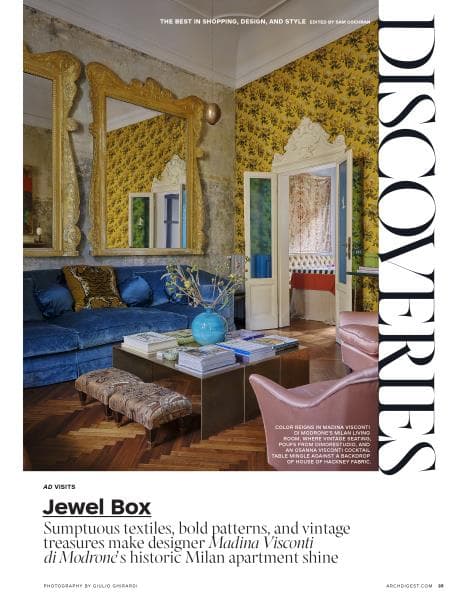
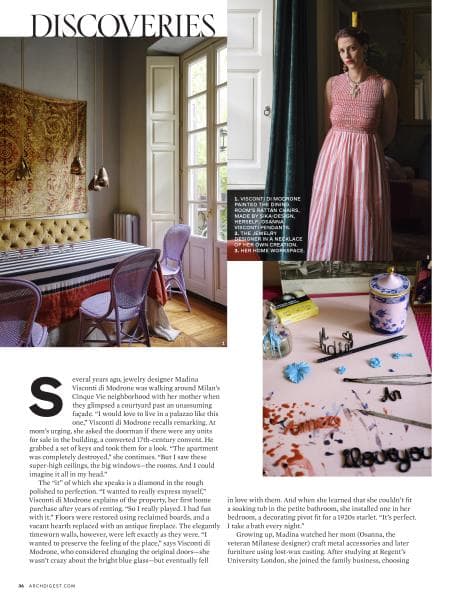
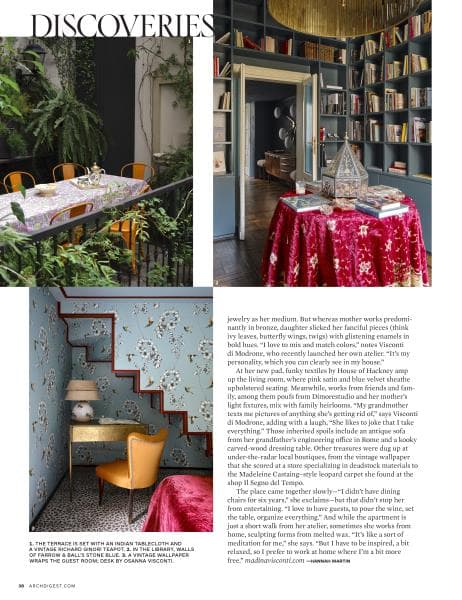
A Milanese jewel box where aristocratic bones meet a young designer's chromatic fearlessness. The 17th-century convent walls were left deliberately timeworn while House of Hackney florals, grandmother's castoffs, and flea-market deadstock pile up in joyful, coherent maximalism. This is inherited provenance dressed in personal exuberance — not performing wealth, but living loudly inside it.
Feature Pages
 p.35
p.35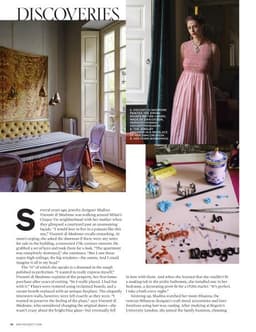 p.36
p.36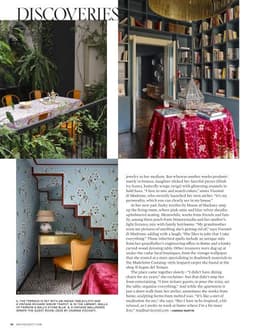 p.38
p.38Home Score
Radial Graph
Space dominates with maximalist exuberance (5) and balanced material warmth (4), while Story maintains steady mid-range coherence across historicism, provenance, and hospitality (all 4), but Stage collapses uniformly across formality, curation, and theatricality (all 2), creating a pattern where intimate maximalist accumulation suppresses any performative or curatorial presentation.
Scoring Explanations
The converted 17th-century convent features super-high ceilings, gilded ornate mirrors, grand doorways, and substantial architectural volume that clearly dominates the rooms, though it remains a residential apartment rather than a palazzo.
Wide herringbone wood floors, blue velvet upholstery, pink satin chairs, rich textiles from House of Hackney, and layered rugs create a predominantly warm tactile environment tempered only by the gilt mirror frames and some harder surfaces.
Every surface is activated — bold floral wallpaper, pattern-on-pattern textiles, vintage furniture, family heirlooms, books, objects on every table, and a deliberate chromatic dialogue between the yellow wallpaper, blue velvet, and pink seating that achieves maximum density with remarkable coherence.
The 17th-century convent architecture with original doors and timeworn walls is committed to its period bones, with vintage furnishings and deadstock wallpapers reinforcing the historical narrative, though funky contemporary textiles and the jewelry designer's modern sensibility create intentional anachronisms.
The article describes inherited pieces from her grandfather's engineering office in Rome, an antique sofa, family heirlooms from her grandmother, her mother Osanna's cocktail table, and timeworn walls deliberately preserved — a genuine mix of inherited and found objects in a building with real age.
The article explicitly states she loves to 'have guests, pour the wine, set the table, organize everything,' didn't have dining chairs for six years but still entertained, and the terrace is set for gathering — the home is clearly oriented toward social life.
Despite the grand architecture and ornate mirrors, the space reads as genuinely lived-in — she didn't have dining chairs for six years, the velvet sofa invites lounging, books and objects are scattered organically, and the article describes her working from home sculpting bronze, making this a creative home not a formal salon.
This is emphatically self-curated — Visconti di Modrone personally sourced vintage wallpaper from specialty shops, inherited family pieces, chose the House of Hackney fabrics herself, and the article describes the place coming together slowly over six years with no designer credited.
The boldness serves her genuine personality as a jewelry designer who loves color and pattern rather than performing for an audience; the wealth is inherited (converted convent, family heirlooms from the Visconti lineage), and the eclectic treasures were dug up at under-the-radar local boutiques rather than branded showpieces.