Homeowner Name
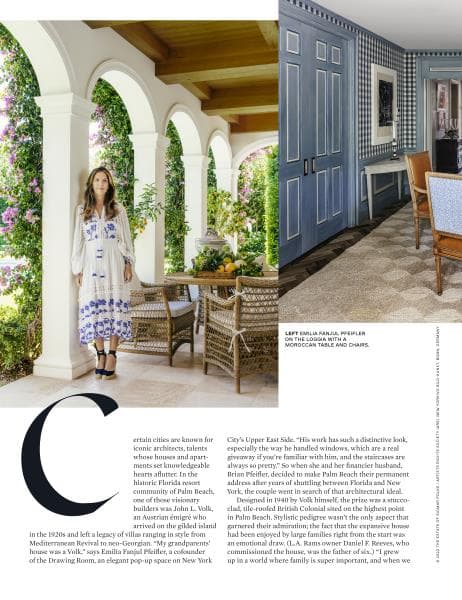
Emilia Fanjul Pfeifler
About (information sourced from public biographical records)
Emilia Fanjul Pfeifler is a Palm Beach socialite and daughter of billionaire sugar magnate José 'Pepe' Fanjul. Her July 2022 Architectural Digest feature showcased her Palm Beach home designed by Frank de Biasi. Born into the Fanjul sugar dynasty (Flo-Sun, Domino Sugar), she attended elite prep schools and married Morgan Stanley wealth advisor.
Epstein Connection?
 DETECTIVE
 RESEARCHER
 EDITOR
Property Details
Wealth Score
2.0
/ 10
Wealth Source
OLD MONEY
Inherited wealth from the Fanjul family sugar empire (Flo-Sun, Florida Crystals,…
Professional Category
SOCIALITE
Fame Score
2
Board Memberships
Young Fellows Ball Co-Chair / Young Collectors Council Member, The Frick Collection; Honorary Co-Chair, Museum Dance, American Museum of Natural History; Donor/Supporter, Museum of Modern Art (MoMA PS1); Unknown (legacy text), The Frick Collection (Young Fellows Ball co-chair / Young Collectors Council member); American Museum of Natural History (honorary co-chair for Museum Dance); MoMA PS1 (donor/supporter); Trustee (2025), John F. Kennedy Center for the Performing Arts; Board Member (2020), Peggy Adams Animal Rescue League; Associates Committee Member / President's Council Member, Society of Memorial Sloan Kettering Cancer Center; Playground Partners Board/Leadership, Central Park Conservancy; Key Leader/Fundraiser Co-Organizer, Glades Academy Foundation; Advisory Board Member, The Family Center (New York); Event Co-Host, Perlman Music Program; Unknown (legacy text), Kennedy Center Trustee (2025, though this may refer to her mother); Peggy Adams Animal Rescue League Board of Directors (2020); Society of Memorial Sloan Kettering Cancer Center (Associates Committee / President's Council); Central Park Conservancy (Playground Partners Board of Directors); Glades Academy Foundation (key leader); The Family Center Advisory Board; Wildlife Conservation Society (trustee-level donor)
Influence Score
—
Architectural Digest Issue:
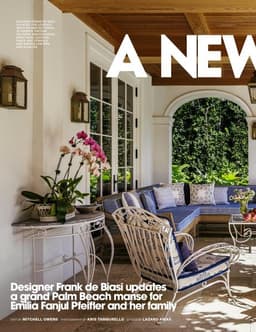
“a new leaf”
by Mitchell Owens
Home Score Summary (Custom Aesthetic Scoring Instrument v2.3)
Palm Beach British Colonial brought to vivid life through a curator's eye and a family's chaos. The blue-and-white gingham, wicker, and salvaged marble create a coherent vision of genteel tropical living that's been deliberately roughed up—splinters in the pine floors, dogs on the furniture, kilims layered over distressed parquet. It's old money aspiration executed with genuine taste and real lived-in warmth.
Feature Pages
 p.102
p.102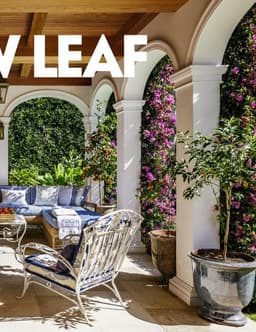 p.103
p.103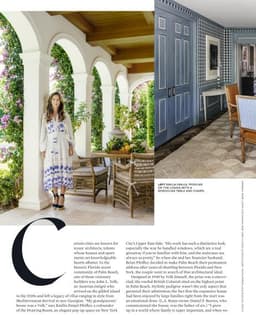 p.104
p.104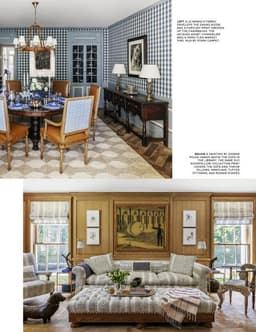 p.105
p.105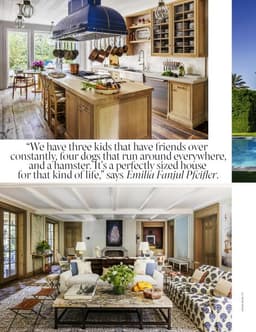 p.106
p.106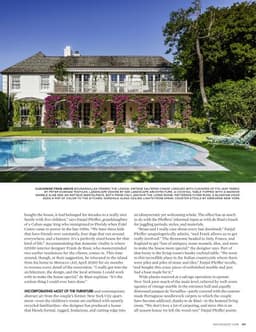 p.107
p.107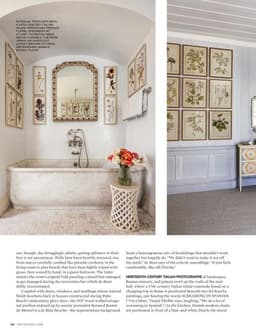 p.108
p.108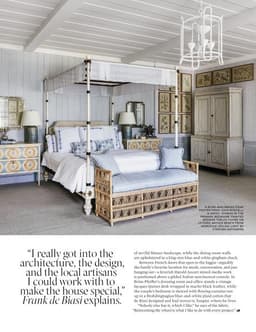 p.109
p.109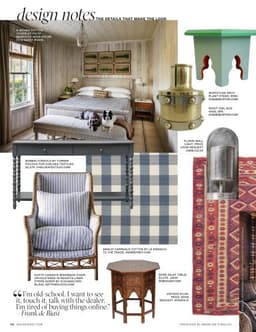 p.110
p.110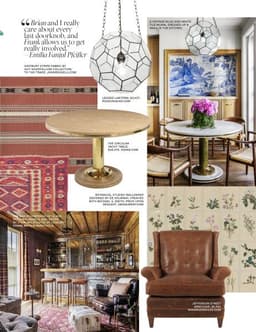 p.111
p.111Home Score
Radial Graph
The Space group dominates with consistent mid-to-high marks anchored by Material Warmth (5), while Story maintains stable coherence across all dimensions, but Stage diverges sharply—driven by elevated Curation (4) against suppressed Formality and Theatricality (both 2)—creating a pattern where deliberate editorial restraint contains rather than amplifies the home's decorative richness.
Scoring Explanations
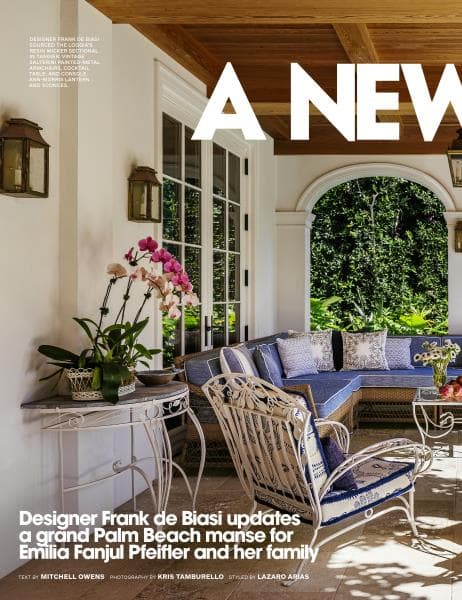
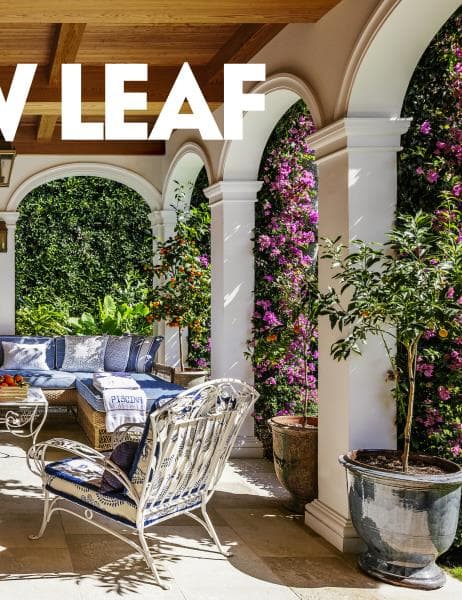
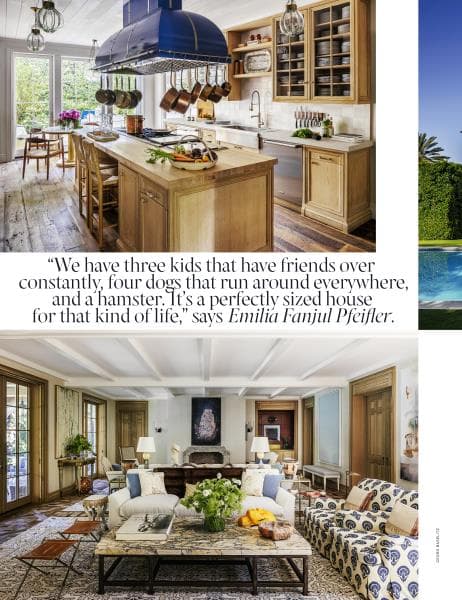
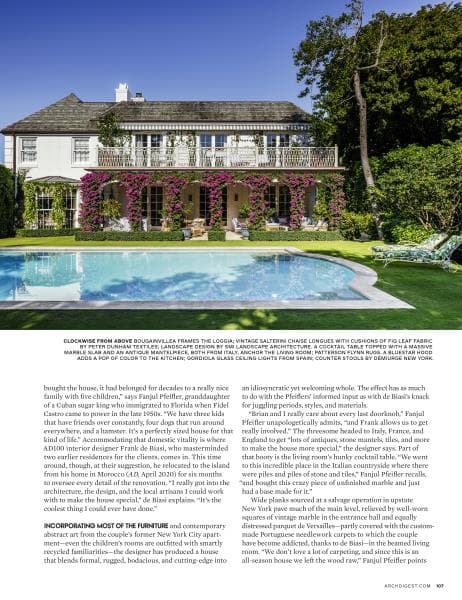
The arched loggia with substantial columns, high wood-beamed ceilings, British Colonial architecture sited on the highest point in Palm Beach, and generous proportions throughout give this home real architectural weight without crossing into palatial excess.
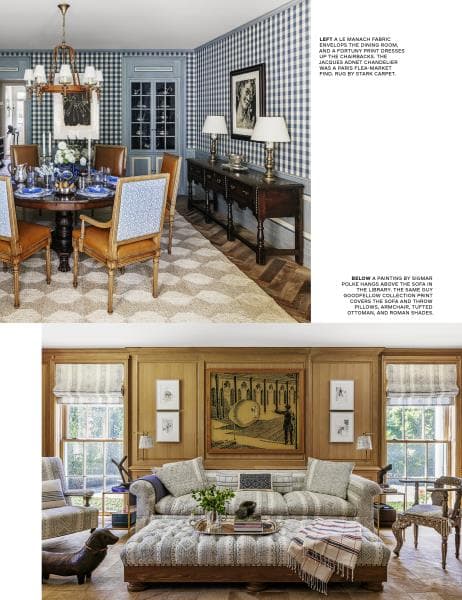
Wide-plank pine floors, oak paneled library, wicker furniture, linen upholstery, terracotta-toned stone floors on the loggia, leather chairs, and natural wood kitchen cabinetry create an overwhelmingly tactile and warm material palette.
Dense layering of patterns (gingham walls, plaid upholstery, kilim rugs, needlework carpets), antiques, botanical prints, and collected objects across every room, all held together by a coherent blue-and-white-and-brown palette with consistent texture relationships.
Strong commitment to the 1940 British Colonial architecture with period-appropriate furnishings—the 1937 octagonal pavilion reference, Jacques Adnet chandelier, Jacques Quinet desk, 19th-century Italian mirrors—with only minor modern intrusions like the kitchen appliances.
The article describes wide-plank floors with splinters, unfinished marble from a salvage operation, flea market finds from Paris, antiques sourced across Italy, France, and England, and the family's Cuban-heritage grandfather's Volk house—mixing genuine inherited history with convincingly aged acquisitions.
The expansive loggia with sectional seating, French doors opening to entertaining spaces, large living room, formal dining room, and the quote about three kids with friends over constantly and four dogs indicate a home designed for generous social life and family gatherings.
Despite the grand architecture, the article emphasizes raw pine floors that give splinters, four dogs running everywhere, kids' friends constantly over, a hamster, and the quote about it being 'a perfectly sized house for that kind of life'—this is a grand house treated as a family home.
Frank de Biasi relocated to Palm Beach for six months to oversee every detail, with styled vignettes throughout (the library's symmetrical arrangement, the loggia's composed seating, the bedroom's carefully placed bone-and-brass four-poster), though the owner's personality and family life clearly penetrate the design.
The wealth is evident but understated—Ed Ruscha paintings, Sigmar Polke, Harold Ancart are present but not brandished; the emphasis is on comfort, patina, flea market finds, and salvaged materials rather than brand-name performance, with the overall feeling being 'old Florida' rather than new money.