Homeowner Name
Jenny Fischbach
About (information sourced from public biographical records)
Jenny Fischbach is an interior designer who worked at Cullman & Kravis before founding her own firm. Her New Jersey home was featured in Architectural Digest's October 2009 issue. She grew up in Westchester County as part of the Sumergrade family (Sumergrade & Sons bedding manufacturers) and married Ben Fischbach of the Acclaim Entertainment family.
Epstein Connection?
 DETECTIVE
 RESEARCHER
 EDITOR
Property Details
Wealth Score
3.0
/ 10
Wealth Source
MIXED
Interior design career (Cullman & Kravis, own firm) combined with family wealth …
Professional Category
ARCHITECTURE_DESIGN
Fame Score
2
Board Memberships
—
Influence Score
—
Architectural Digest Issue:
“in the georgian fashion”
by Gerald Clarke
Home Score Summary (Custom Aesthetic Scoring Instrument v2.3)
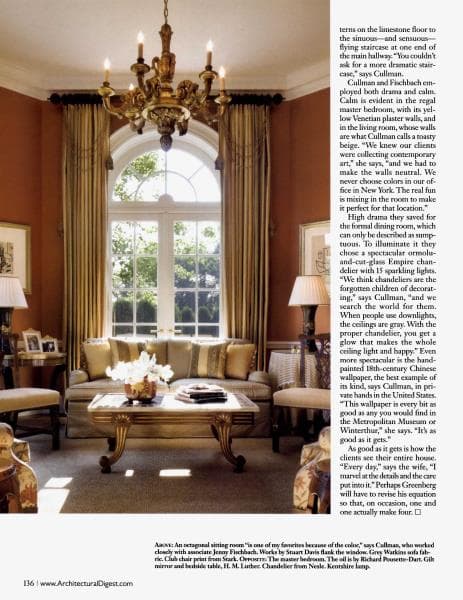
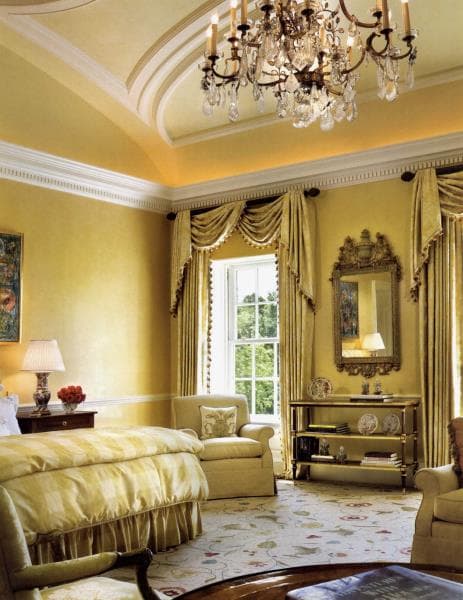
A new-build Georgian fantasy executed with absolute conviction — the architecture and decoration are so committed to their 18th-century source material that the house achieves a kind of theatrical perfection that real Georgian houses never had. The collaboration between Greenberg and Cullman & Kravis produces rooms of museum-quality finish where every molding, chandelier, and wallpaper panel exists in perfect period dialogue, but the total absence of wear or accident betrays its 21st-century birth. It's a magnificent costume, impeccably tailored.
Feature Pages
 p.132
p.132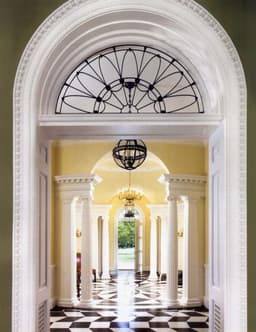 p.133
p.133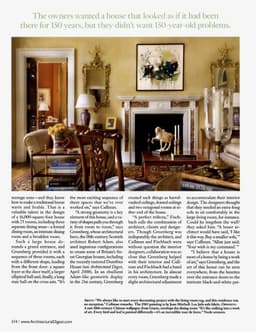 p.134
p.134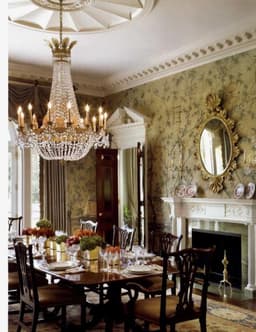 p.135
p.135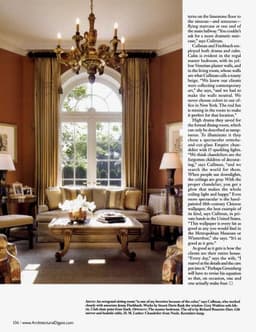 p.136
p.136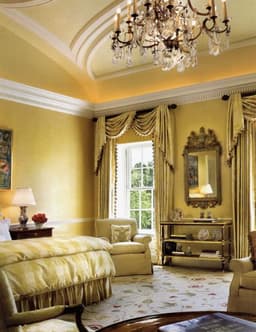 p.137
p.137 p.138
p.138 p.139
p.139Home Score
Radial Graph
The Stage group dominates with theatrical formality and curation discipline (4.7), suppressing Story's weaker Provenance score (2) while Space's Grandeur and Material Warmth provide foundational support, creating a pattern where historical commitment in architecture and decoration is undermined by sparse evidence of lived use or genuine object history.
Scoring Explanations
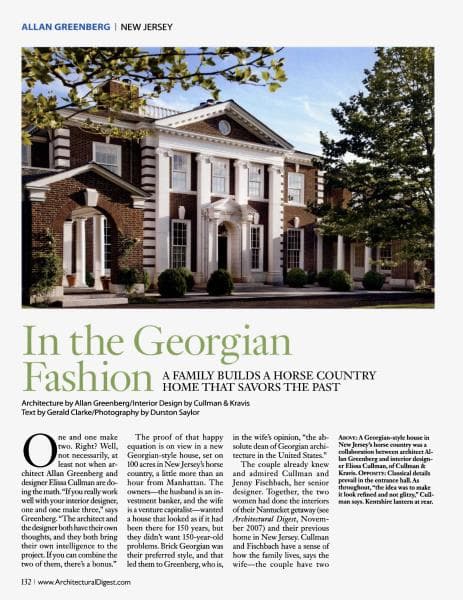
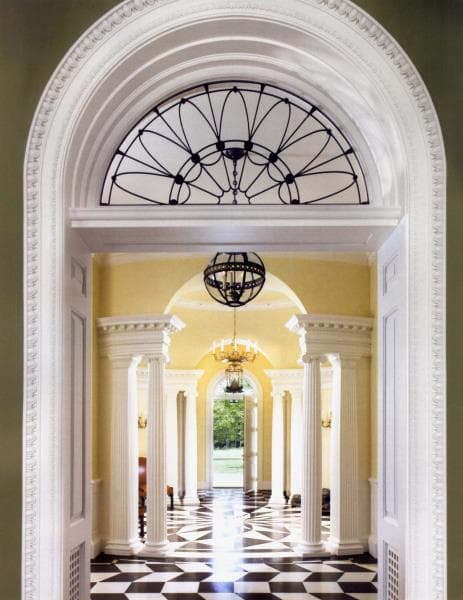
Triple-height entrance hall with arched fanlights, columned corridors, barrel-vaulted and domed ceilings, black-and-white marble floors, and Empire chandeliers — this is a 16,000-square-foot Georgian mansion that dominates its occupants at every turn.
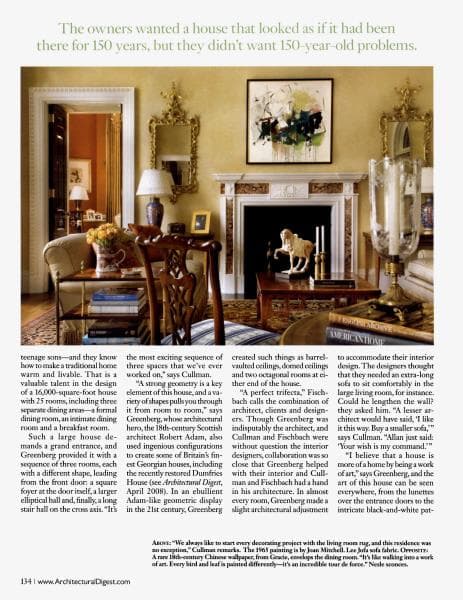
Despite the marble entrance hall, the predominant experience is warm: yellow Venetian plaster walls, rich mahogany furniture, hand-painted Chinese wallpaper, heavy silk drapery, and upholstered seating throughout the living spaces.
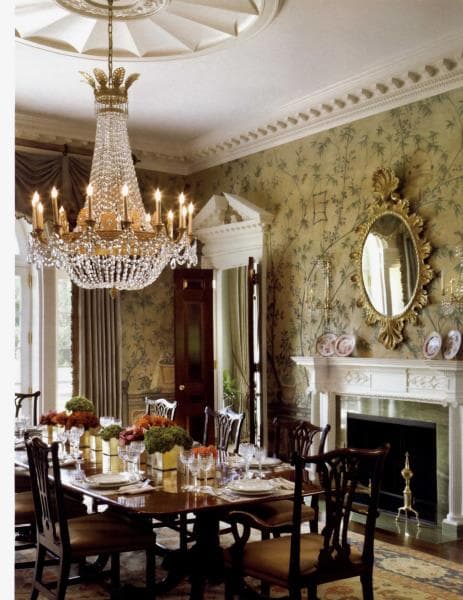
Dense layering of pattern-on-pattern — Chinese wallpaper, ornate gilt mirrors, crystal chandeliers, Chippendale chairs, elaborate crown moldings, and layered textiles — all in coherent Georgian dialogue without a single discordant note.
The entire house was purpose-built to look as if it had been there 150 years, drawing on Robert Adam's 18th-century Scottish designs, with hand-painted 18th-century Chinese wallpaper, period-appropriate Chippendale furniture, and no visible anachronisms in any photograph.
The article explicitly states this is new construction designed to look 150 years old — everything is pristine, purchased, and placed; the 18th-century wallpaper is museum-quality but arrived all at once, and no evidence of genuine wear or inherited accumulation exists.
The house features three separate dining areas, a formal entrance sequence designed for flow, grand public rooms scaled for entertaining, and the article mentions the family with teenage sons but the dominant spaces are clearly designed for receiving guests.
Every room enforces behavioral rules — the marble-floored columned hall, the formal dining room with its Empire chandelier and set table, the master bedroom with silk swags and no personal clutter; these are spaces where you stand up straighter involuntarily.
Cullman & Kravis and Jenny Fischbach styled every vignette with deliberate symmetry, composed sight lines through arched doorways, and the article confirms they collaborated on every room's architectural adjustments — this is fully designer-directed for editorial impact.
Building a brand-new 16,000-square-foot Georgian mansion on 100 acres with hand-painted Chinese wallpaper described as 'the best example of its kind in private hands in the United States' is a significant wealth performance, though the Georgian idiom channels it through taste rather than brand names.