Homeowner Name
Arnold Scaasi
About (information sourced from public biographical records)
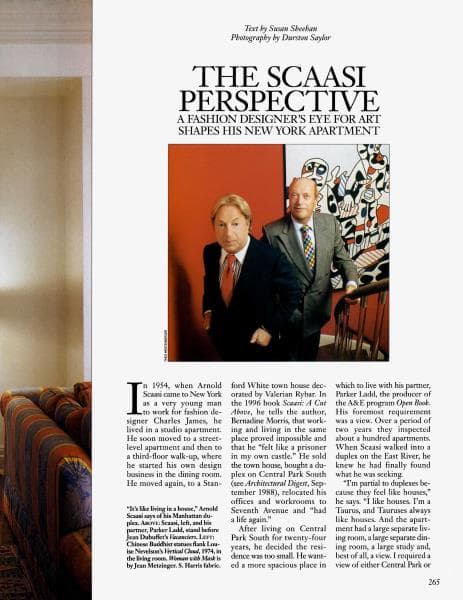
Arnold Scaasi was a couture fashion designer who dressed five First Ladies and numerous celebrities. His Manhattan townhouse at 26 West 56th Street was featured in Architectural Digest in November 2000. Born Arnold Isaacs in Montreal to a middle-class Jewish family with a furrier father, he built his fashion empire from $2,000 in savings after training in Paris.
Epstein Connection?
 DETECTIVE
 RESEARCHER
 EDITOR
Property Details
Wealth Score
7.0
/ 10
Wealth Source
SELF MADE
Fashion design empire: couture salon, ready-to-wear lines, licensing deals (frag…
Professional Category
FASHION
Fame Score
7
60,178 wiki views
Board Memberships
Unknown (legacy text), None found (though his work is held by the Metropolitan Museum of Art, Museum of Fine Arts Boston, FIT, and the Smithsonian); Founding Member, Council of Fashion Designers of America (CFDA); Co-Founder and Board Member, Literacy Partners Inc.; Unknown (legacy text), Co-founder and Board of Directors, Literacy Partners Inc.; Founding member, Council of Fashion Designers of America (CFDA)
Influence Score
—
Architectural Digest Issue:
“the scaasi perspective”
by Susan Sheehan
Home Score Summary (Custom Aesthetic Scoring Instrument v2.3)
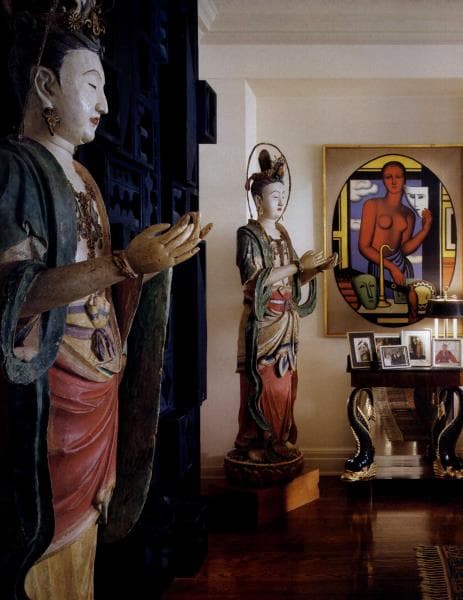
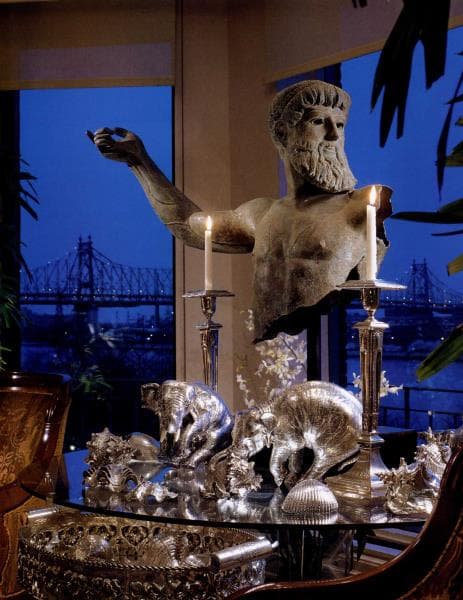
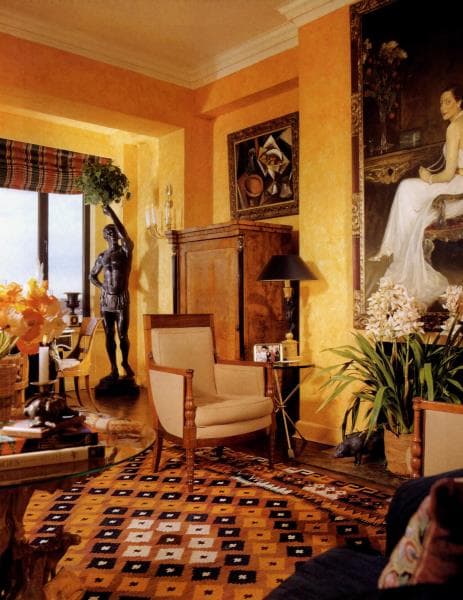
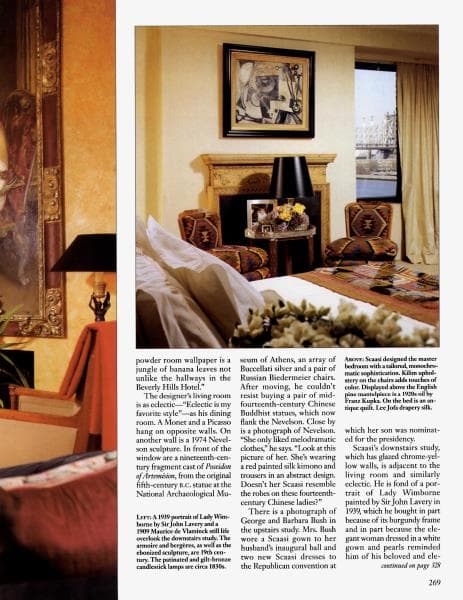
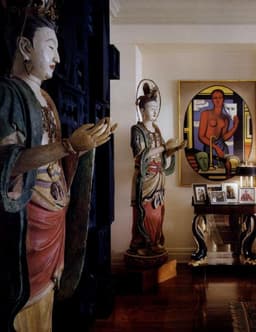
A fashion designer's maximalist salon where fourteenth-century Chinese Buddhist statues stand sentinel beside Nevelson ceiling appliqués and a Greek bronze fragment presides over massed Buccellati silver — eclectic not as excuse but as ideology. The glazed yellow walls and mirrored dining room create a hothouse atmosphere that is equal parts personal museum and stage set for New York social life. Every object has a story Scaasi wants to tell you.
Feature Pages
 p.264
p.264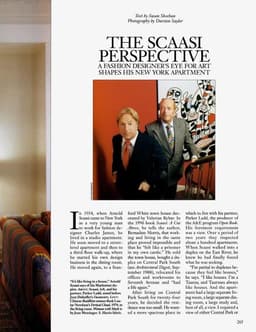 p.265
p.265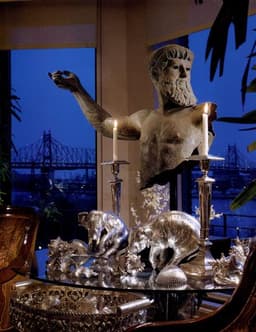 p.266
p.266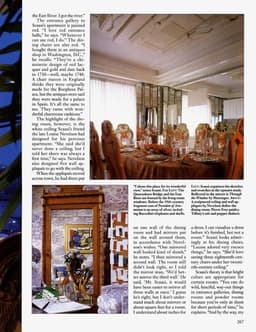 p.267
p.267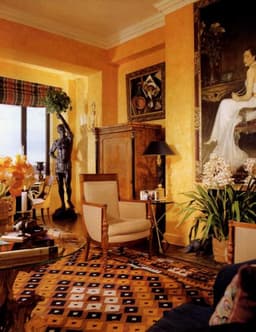 p.268
p.268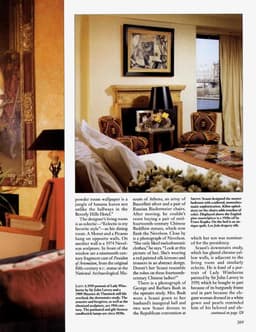 p.269
p.269Home Score
Radial Graph
Space dominates at 4.3 through Maximalism's commanding 5, while Stage achieves equilibrium at 4.0 across all three axes, and Story lags at 3.3 due to Historicism's suppressed 2 despite strong Provenance and Hospitality scores, creating a pattern where dense material accumulation outpaces narrative grounding.
Scoring Explanations
High ceilings in the duplex with generous proportions, mirrored dining room walls, gilded frames, and the scale of the Buddhist statues and Poseidon cast all speak to substantial architectural volume and material weight.
Glazed chrome-yellow walls, warm sponged golden surfaces, rich upholstery, kilim rugs, wood floors, and abundant plants create a predominantly warm tactile environment despite some reflective silver and mirror surfaces.
Every surface is activated — fourteenth-century Chinese Buddhist statues flanking a Nevelson, Buccellati silver shells massed on a table before a Poseidon fragment, art layered on art, framed photos crowding consoles — yet it all speaks a consistent language of eclectic connoisseurship.
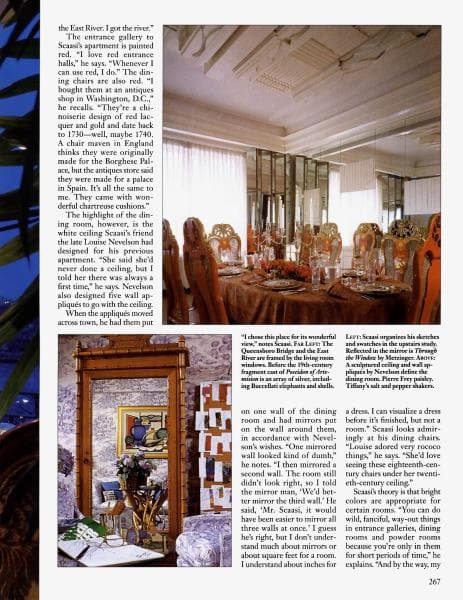
Scaasi explicitly declares 'Eclectic is my favorite style' and freely mixes fourteenth-century Chinese statues, eighteenth-century red lacquer chairs, a nineteenth-century Greek bronze cast, Art Deco painting, and Nevelson ceiling appliqués with no commitment to any single period.
Objects were accumulated over decades of a long career — the Nevelson ceiling was designed for his previous apartment, the red lacquer chairs were found at a D.C. antiques shop, the Lavery portrait was bought in 1939 for its frame and personal resonance — creating genuine biographical layering.
The duplex was chosen specifically for its large separate living room, large separate dining room, and study, and the mirrored dining room with its elaborate table settings and red lacquer chairs signals a space designed for entertaining guests in grand fashion.
The mirrored dining room with possibly-Borghese-Palace chairs, the carefully arranged silver collections, the museum-scale statuary, and the styled vignettes throughout impose clear behavioral rules — these are rooms to be admired, not lounged in casually.
Though self-directed by Scaasi (a fashion designer with a trained eye), the composed sight lines — Buddhist statues framing a painting, the Poseidon silhouetted against the Queensboro Bridge at twilight, symmetrical object arrangements — reveal highly deliberate editorial staging.
The apartment performs wealth and taste loudly — name-dropping Nevelson ceilings, Buccellati silver, a cast of the Poseidon of Artemision, photos with Barbara Bush, and the view of the East River all signal a space that wants its audience to know the biography and the price.