Homeowner Name
Ismail Merchant
About (information sourced from public biographical records)
Ismail Merchant (1936-2005) was an Indian-born film producer who co-founded Merchant Ivory Productions, producing over 40 films including A Room with a View and Howards End. His Paris apartment, decorated by Angelo Manciolfi, was featured in Architectural Digest in April 1996. Born into a prosperous Bombay textile merchant family with his father serving as President of the Muslim League, Merchant moved to New York at 22 and built his film company from scratch while working as a UN messenger.
Epstein Connection?
 DETECTIVE
 RESEARCHER
 EDITOR
Property Details
Wealth Score
5.0
/ 10
Wealth Source
MIXED
Film production — co-founder of Merchant Ivory Productions; also income from coo…
Professional Category
ENTERTAINMENT
Fame Score
8
1,052,738 wiki views
Board Memberships
Co-Founder, Merchant and Ivory Foundation; Advisory Board Member, Indo-American Arts Council (IAAC); Unknown (legacy text), Indo-American Arts Council (Advisory Board); Merchant and Ivory Foundation (co-founder, 1991/1992)
Influence Score
—
Architectural Digest Issue:
“ismail merchant”
by Joseph Giovannini
Home Score Summary (Custom Aesthetic Scoring Instrument v2.3)
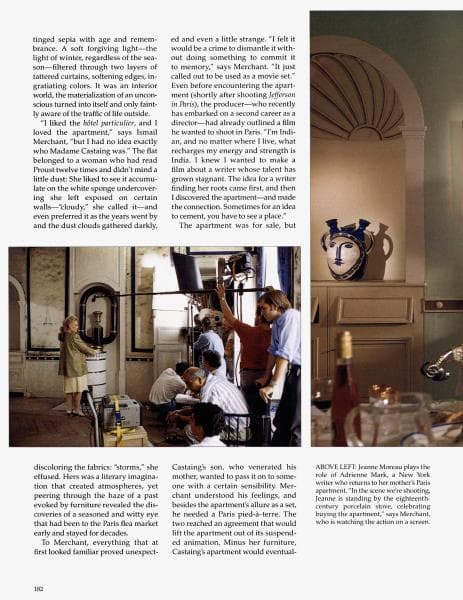
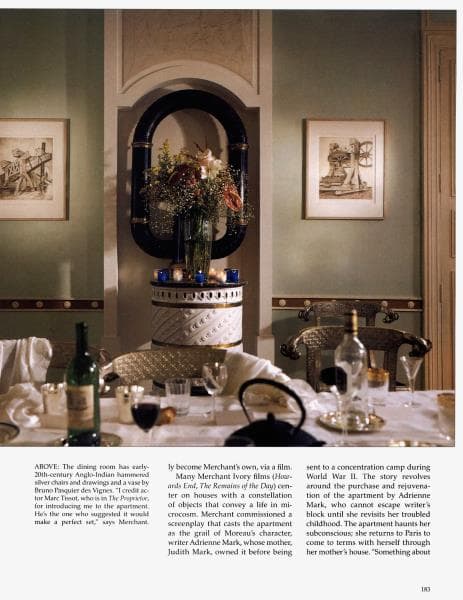
A haunted Parisian salon where Madeleine Castaing's ghost lingers in every tattered curtain and dust-darkened fabric, now overlaid with Ismail Merchant's Indo-cosmopolitan sensibility. The apartment is genuine accumulation made cinematic — a real place that became a film set precisely because it couldn't be designed. Patina here isn't a style choice; it's biography.
Feature Pages
 p.178
p.178 p.179
p.179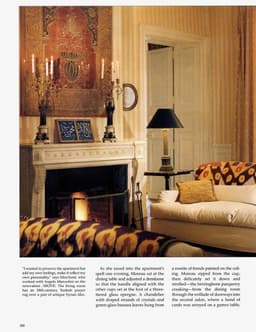 p.180
p.180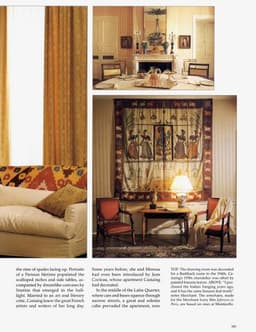 p.181
p.181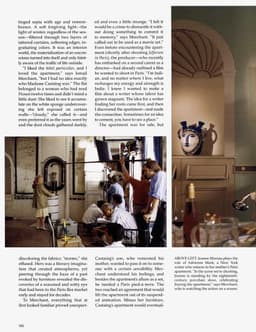 p.182
p.182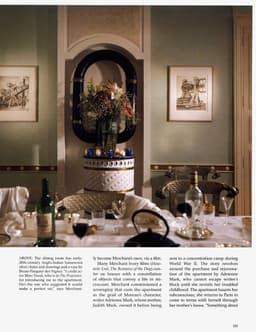 p.183
p.183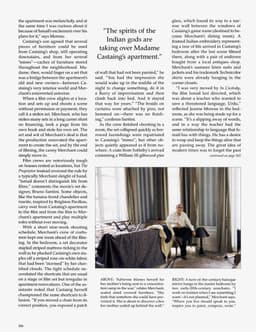 p.184
p.184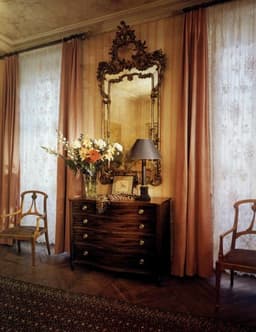 p.185
p.185Home Score
Radial Graph
The score pattern reflects a home where balanced spatial richness and narrative depth (both 4.0) diverge sharply downward in performative staging (3.0), suppressed by moderate Theatricality and Curation despite strong Formality, suggesting accumulated authenticity dominates over deliberate aesthetic orchestration.
Scoring Explanations
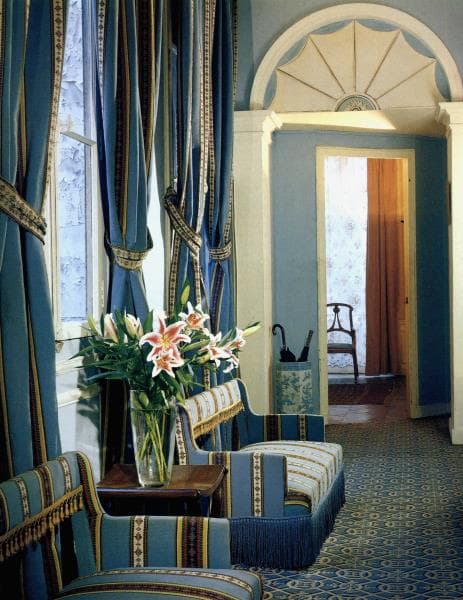
High ceilings with arched doorways, shell-motif pediments, herringbone parquetry floors, and generous room proportions throughout this classic Parisian apartment convey substantial architectural weight.
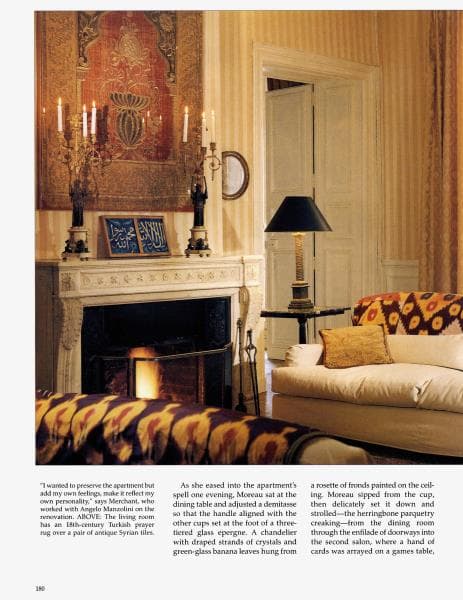
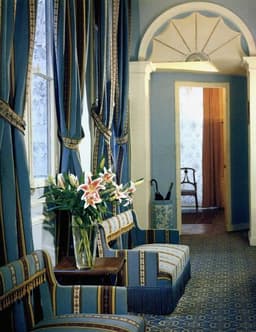
Rich draperies in deep blue and gold, upholstered furniture, Turkish prayer rugs, tapestries, warm-toned wallpapers, and mahogany furniture create a predominantly warm, enveloping tactile environment.
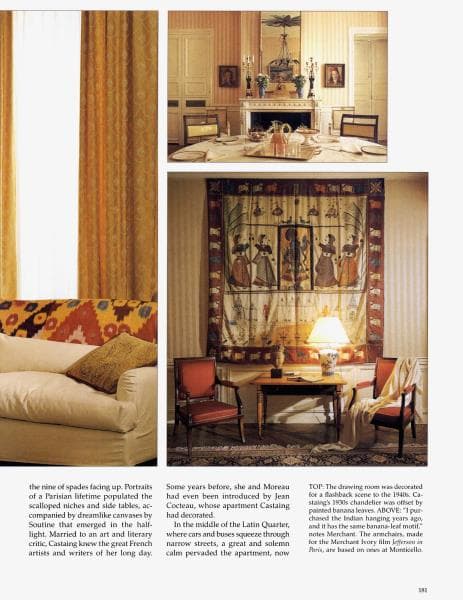
Dense layering of tapestries, paintings, Islamic calligraphy, candelabras, framed art, patterned fabrics, and collected objects from multiple cultures — all in coherent dialogue through warm color palettes and historical sensibility.
The apartment commits strongly to a French decorative tradition spanning 18th-19th centuries with period furniture, Baroque mirrors, herringbone parquet, and classical architectural details, with only minor modern intrusions like film equipment during shooting.
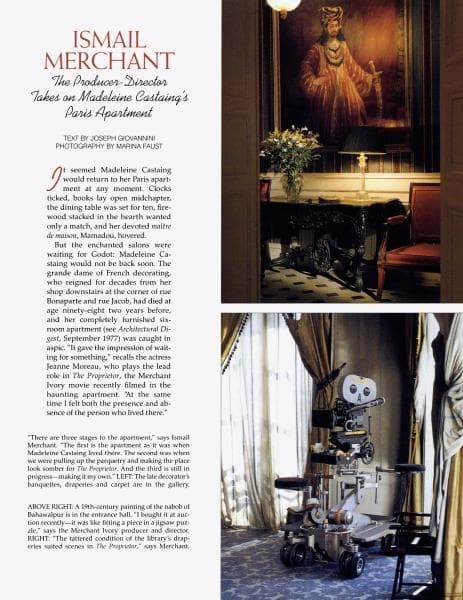
The article explicitly describes Madeleine Castaing's decades of genuine accumulation — 'dust clouds gathered darkly, discoloring the fabrics: storms, she effused' — with tattered curtains, worn surfaces, and the patina of a real life lived across generations in this apartment.
The apartment serves as both a personal retreat and a social space — the article describes dining tables set for guests and salons for entertaining, but the intimate scale and deeply personal accumulations suggest balanced private and social use.
The careful arrangement of formal French salon furniture, symmetrical drapery compositions, precious antiques, and the overall atmosphere of a grande dame's apartment enforces behavioral restraint despite the lived-in patina.
Merchant worked with Angelo Manciolfi on renovation and production designer Bruno Santini styled for film, but the core collection reflects Castaing's deeply personal decades-long accumulation and Merchant's own Indian sensibility layered on top.
The wealth here is inherited from Castaing's legacy and expressed through connoisseurship rather than brand performance — the 18th-century Turkish prayer rug, antique Syrian tiles, and Indian embroidery serve personal cultural identity rather than outside audiences.