Homeowner Name
Allan Katz
About (information sourced from public biographical records)
Allan Katz is a leading American folk art dealer and Antiques Roadshow appraiser. His 1771 Connecticut home was featured in AD's March 1993 issue. He co-founded Parametrics Industrial Electronics in 1969, sold it in the early 1980s, and used proceeds to build his folk art business.
Epstein Connection?
 DETECTIVE
 RESEARCHER
 EDITOR
Property Details
Wealth Score
8.0
/ 10
Wealth Source
SELF MADE
Co-founded Parametrics Industrial Electronics Co. in 1969, sold in early 1980s; …
Professional Category
ART
Fame Score
6
70,145 wiki views
Board Memberships
Trustee/Board Member, American Folk Art Museum; Fellow, American Folk Art Museum - Jean Lipman Fellows; Unknown (legacy text), American Folk Art Museum (NYC) — Trustee and Board Member; Jean Lipman Fellows member at the American Folk Art Museum; Treasurer of the Board, Antique Dealers Association of America (ADA); Unknown (legacy text), Antique Dealers Association of America (ADA) — Treasurer of the Board; Winter Antiques Show / American Antiques Show — Dealer Advisory Committee
Influence Score
—
Architectural Digest Issue:
“connecticut folk tale”
by Nicholas Fox Weber
Home Score Summary (Custom Aesthetic Scoring Instrument v2.3)
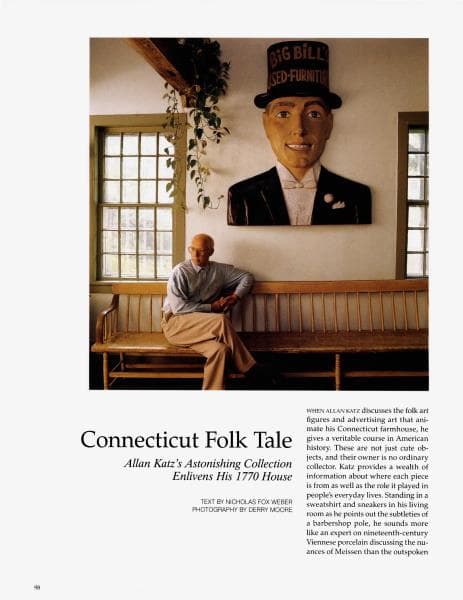
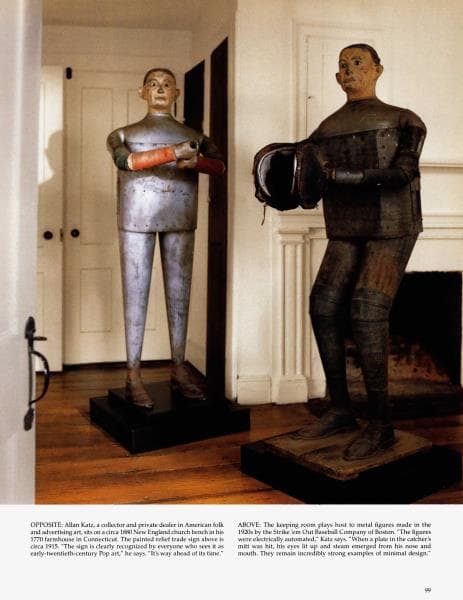
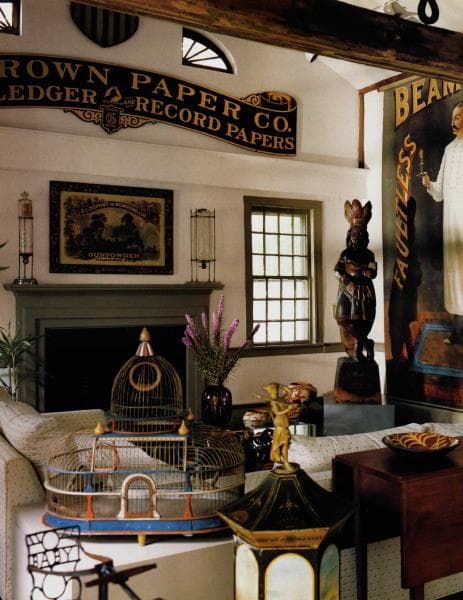
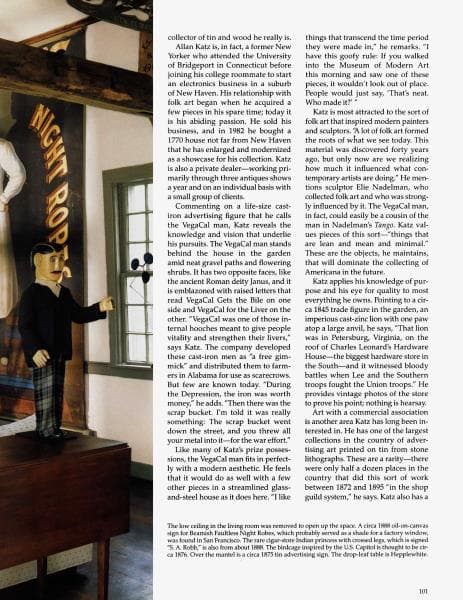
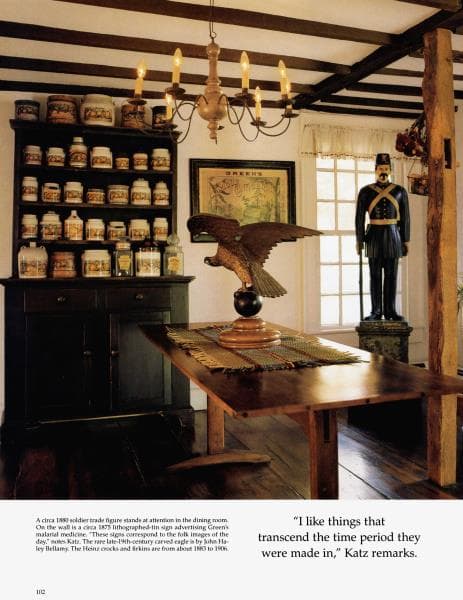
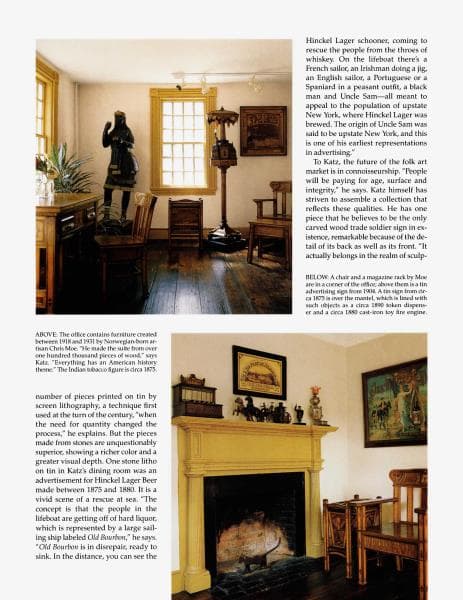
A scholar-dealer's farmhouse where American folk art isn't displayed but inhabits the rooms like a population of tin men, carved mannequins, and trade figures that have found their permanent address. The 1770 architecture is a humble servant to the collection — low ceilings and exposed beams creating the perfect scale for life-size cast-iron advertising figures and stone-lithographed signs that Katz treats as sculpture rather than antiques. Nothing here performs for anyone but the collector himself.
Feature Pages
 p.98
p.98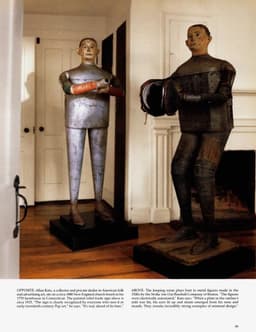 p.99
p.99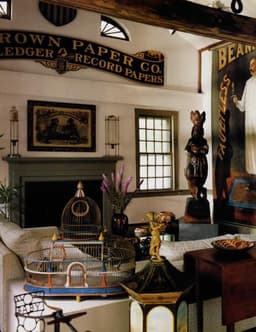 p.100
p.100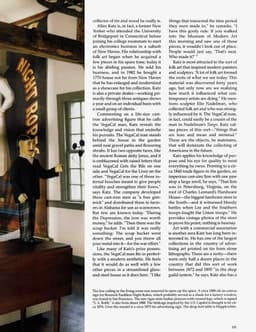 p.101
p.101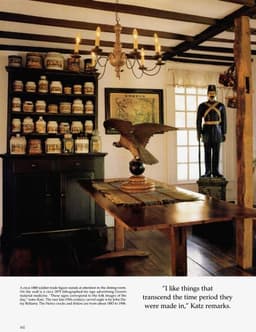 p.102
p.102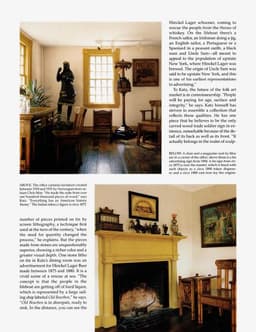 p.103
p.103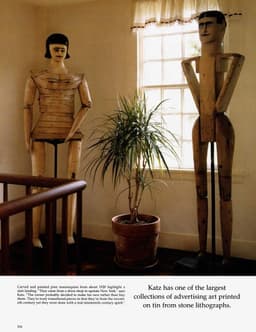 p.104
p.104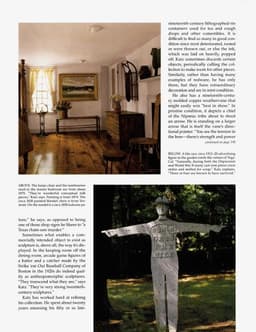 p.105
p.105Home Score
Radial Graph
The score pattern reflects a home dominated by Story's narrative depth (Historicism and Provenance both at 5) while Stage's performative dimensions are systematically suppressed (all three axes at 1–2), creating a collector-centric rather than viewer-centric aesthetic that Space's material authenticity (high Warmth and Maximalism) supports but its modest Grandeur (2) does not amplify.
Scoring Explanations
A 1770 Connecticut farmhouse with low ceilings, exposed beams, and human-scale rooms — the architecture is modest colonial vernacular, not imposing.
Wide-plank wood floors, exposed timber beams, painted pine mantels, worn wooden furniture, woven textiles, and terracotta — every surface is tactile and natural.
Every room is dense with folk art figures, trade signs, birdcages, lithographed tins, carved mannequins, and advertising art, yet all objects share a coherent American folk vocabulary in constant dialogue.
The 1770 house serves as an authentic period shell for 19th-century American folk and advertising art with no visible modern anachronisms — even the furniture (banjo chairs, church benches, Shaker-style pieces) is era-appropriate.
Twenty years of personal collecting refined over time, housed in a genuine 1770 farmhouse; the article describes Katz culling pieces and knowing the origin story of every object, and the patina on the trade figures and tin signs is unmistakably real.
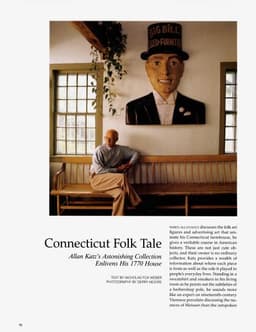
The article describes Katz standing alone in sweatshirt and sneakers discussing his collection — this is a deeply personal museum-home designed for the collector's own communion with his objects, not for entertaining.
Despite the museum-density of objects, Katz is photographed casually on a church bench in sneakers; the rooms feel like a lived-in farmhouse where you'd sit comfortably among the folk art.
This is entirely self-curated by a passionate private dealer-collector who personally acquired every piece over decades with deep knowledge of provenance and context — no designer hand is evident.
The collection serves Katz's personal obsession with American folk art and advertising history; he describes pieces in terms of their cultural significance and sculptural quality, not their market value, and the objects are esoteric enough that most visitors wouldn't recognize their worth.